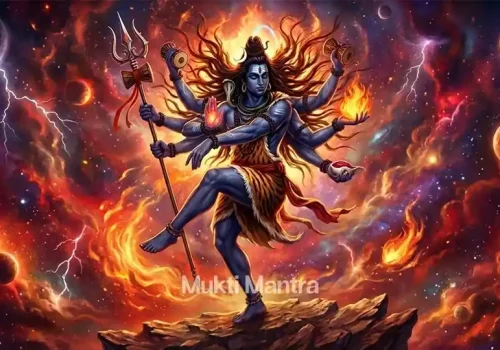
The Ashutosh Shashank Shekhar Lyrics is a Stuti dedicated to Lord Shiva, praising him through powerful names that reflect his divine qualities, cosmic authority and his compassionate nature. This stuti is widely recited by devotees to seek peace, protection and spiritual strength. It celebrates Shiva’s presence as both the supreme God and the easily approachable deity who responds to only sincere prayer.
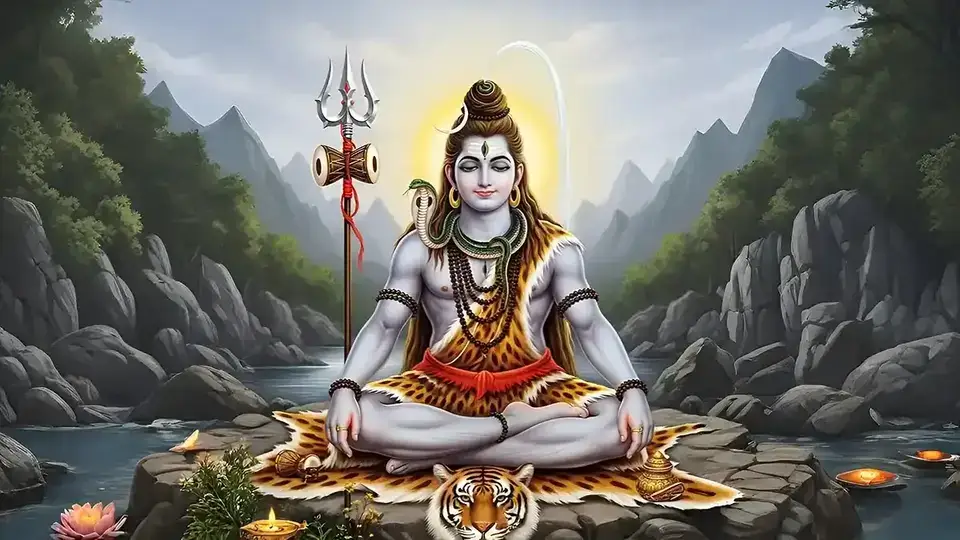
Ashutosh Shashank Shekhar Lyrics in English
Ashutosh Shashaank Shekhar,
Chandra Mauli Chidambara,
Koti Koti Pranam Shambhu,
Koti Naman Digambara.
Nirvikaar Omkaar Avinaashi,
Tumhi Devaadhi Dev,
Jagat Sarjak Pralay Karta,
Shivam Satyam Sundara.
Niraankaar Swaroop Kaleshwar,
Maha Yogeeshwara,
Dayaanidhi Daanishwar Jai,
Jataadhaari Abhayankara.
Shool Paani Trishool Dhaari,
Augadi Baaghambari,
Jai Mahesh Trilochanaaya,
Vishwanaath Vishambhara.
Naath Naageshwar Haro Har,
Paap Saap Abhishaap Tam,
Mahadev Mahaan Bhole,
Sadaa Shiv Shiv Shankara.
Jagat Pati Anurakti Bhakti,
Sadaiv Tere Charan Ho,
Kshama Ho Apraadh Sab,
Jai Jayati Jagadeeshwara.
Janam Jeevan Jagat Ka,
Santaap Taap Mite Sabhi,
Om Namah Shivaaya Man,
Japta Rahe Panchakshara.
Ashutosh Shashaank Shekhar,
Chandra Mauli Chidambara,
Koti Koti Pranam Shambhu,
Koti Naman Digambara.
Koti Naman Digambara…
Koti Naman Digambara…
Koti Naman Digambara…
Written by: Lyrics based on ancient Shiva Stutis, composed by Nikhil-Vinay for the 1997 album ‘Shiv Mahapuran’
Presented By: Mukti Mantra
Deeper meaning Ashutosh Shashank Shekhar Lyrics:
The Ashutosh Shashank Shekhar Lyrics describe Lord Shiva in his most divine, cosmic, and compassionate forms. He transcends shape, time, and identity, revealing himself through countless divine names in these verses. It guides the devotee to see beyond simple praise and into a deeper understanding of Shiva’s nature as the unchanging, formless, and ever-present consciousness that governs all life. Devotees praise Him as the easily pleased Lord, the moon-adorned, the creator as well as the destroyer, the fearless yogi, the compassionate giver, and the silent truth that resides within every soul. Below is a detailed exploration of every stanza, revealing the deeper meaning behind the names, symbols, and teachings embedded within this sacred hymn.
Shiva as Ashutosh and Chidambara
The verses open by addressing Lord Shiva as Ashutosh, meaning the easily pleased Lord. It is believed that Lord Shiva is the easiest to please; he gets pleased only by “Ek Lota Jal” when offered with true heart and full devotion. Further, the lyrics call him Shashank Shekhar, where Shashank refers to the Moon, and Shekhar means crown, referring to the crescent moon that rests on his head. The resting of the moon over Shiva’s head symbolises the mastery over emotions and his ability to remain steady in all situations. This also highlights his control over Satva Gunna.
The world Chandra Mauli and Chidambara dwell further on this description. “Chandra Mauli” refers again to the crescent moon on Shiva’s head, and Chidambara refers to the limitless, infinite consciousness or the vast expanse of the cosmos, identifying Shiva as the divine space where everything exists. The name Chidambara is a reminder that Shiva also lives as vast awareness within every being. In the lines “Koti Koti Pranam Shambhu, Koti Naman Digambara”, the word “koti” in Sanskrit means crore, repeating it twice signifies Millions and millions of salutations to Lord Shambu, the source of happiness and Digambara, meaning the one who wears the sky as clothing, symbolising detachment and vastness.
The very first verse in the Ashutosh Shashank Shekhar Lyrics presents the idea of Shiva’s existence beyond his physical form as Shankara. He resides in the vast expanse of the universe and is the source from which everything emerges.
Shiva, the Eternal Omkaar and the Cosmic Cycle
The second verse presents Shiva as the eternal and unchanging truth. The word “Nirvikaar” means the one who is constant and unaffected by external changes. Shiva remains the steady reality behind all creation. As “Omkaara”, he signifies the ultimate, formless reality (Brahman) and that he is the source of all creation, preservation, and destruction. According to Shaivism, the sound “om” emerges from Lord Shiva’s damru. He is “Avinaashi”, meaning the eternal one.
The lyrics further say, “Tumhi Devaadhi Dev,” referring to Shiva as the highest of Gods, who is Mahadeva, the source from which all divine power originates. It also describes him as “Jagat Sarjak Pralay Karta Shivam Satyam Sundara”, meaning he is the one who creates, nourishes and destroys this universe. Just as he manifests this world, he also absorbs it back into himself.
It also suggests that auspiciousness, truth, and beauty are not separate qualities, but rather a reflection of Shiva’s essence. He is the only truth, and what is Truth is Shiva.
Shiva as the Formless Master of Time in Ashutosh Shashank Shekhar Lyrics
The third verse describes Shiva in his Niraankaar Swaroop, the formless reality that transcends all shape and structure. This verse in Ashutosh Shashank Shekhar Lyrics also serves as a message to the devotee that the divine transcends idols or images, as he is the boundless consciousness present in our every breath. As Kaleshwar, he is the Lord of time, he is Mahakaal, the one who is beyond time and unaffected by past, present or future.
Calling him “Maha Yogeeshwara” highlights his identity as the supreme Yogi. He is Adi Yogi, the one who taught the science of yoga to the world. His stillness teaches about the power of self-control and inner balance. The verse continues with Dayaanidhi Daanishwar, portraying Shiva as the embodiment of compassion and generosity. He gives without hesitation and receives all with love. Shiva consumed poison to save the world, bearing its pain and is so simple that he gets impressed by everything that is offered to him with true devotion, even if it’s water or simple things like Belpatra.
He is also referred to as “Jataadhaari”, meaning the one with matted locks of hair and is referred to as “Abhayankara”, the remover of fear.
Shiva as the Wielder of the Trishul and the Third Eye
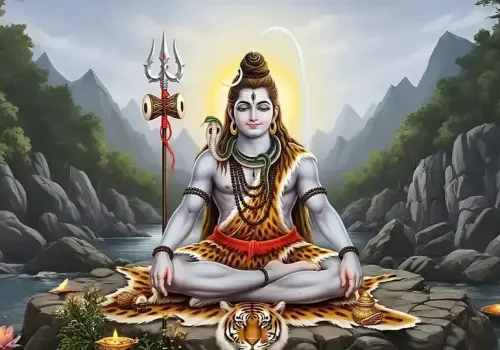
This verse in Ashutosh Shashank Shekhar Lyrics talks about Shiva as “Shool Paani Trishool Dhaari”, meaning the one holding the trishul, he is the destroyer, but he not only destroys the universe but also ignorance, injustice and all the negative emotions within a being that stop their spiritual upliftment. The words “Aaugadi Baaghambari” refer to Shiva wearing the tiger skin. Beyond his clothing, the tiger skin also represents his control over fear, uncontrolled desires and the animal instincts. By sitting upon the skin of a fierce creature, Shiva demonstrates that true mastery begins within one’s own mind. It also shows his mastery over Rajas Gunna.
The verse continues with “Jai Mahesh Trilochanaaya”, referring to the third eye of Lord Shiva. The third eye represents awakened wisdom, the ability to see beyond illusion and perceive the truth hidden beneath appearances. When a devotee worships Shiva, Shiva can see beyond their words and physical appearances. When the third eye opens, it destroys. But for a devotee, it destroys the ignorance and negative qualities within the devotee. Finally, calling him “Vishwanaath” and “Vishambhara” honours him as the Lord and sustainer of the universe.
Shiva as the Remover of Sins, Fear, and Darkness
The fifth verse highlights Shiva’s power and ability to reverse all the wrong deeds done by a devotee, remove the curse and the misfortune that came as a result of the curse in the lines “Haro Har Paap, Saap, Abhishaap Tam.” He is called “Naath Naageshwar”, the lord of Snakes, as the snakes represent his mastery over kundalini energy and also time (kaal).
Lord Shiva’s grace purifies the hearth and restores inner peace. Calling Him “Mahadev Mahaan Bhole” emphasises His innocence and simplicity, which makes Him Lord of all other devas. He is as pure as a child, although this divine strength comes from his complete detachment. The final line, “Sadaa Shiv Shiv Sankara”, reminds us that Shiva is eternal, ever-auspicious, and ever-present.
The verse in Ashutosh Shashank Shekhar Lyrics calls upon Lord Shiva to help devotees and free them from their past actions. However, it is important to understand that Shiva does not remove the past karma just because the devotee prays. It is a blessing that one can attain only by walking on the path of Dharma, doing every action for the benefit of others and by living a conscious life.
Shiva, the Lord Who Accepts Surrender and Devotion in Ashutosh Shashank Shekhar Lyrics
After calling upon Shiva to remove their troubles, this verse expresses deep surrender. Calling Shiva Jagat Pati, the Lord of the universe, acknowledges His supreme authority over creation. The word “Anurakti Bhakti” combines Anurakti, meaning deep, passionate, all-encompassing loving attachment to the Divine that is beyond rituals.
Here, the devotee calls Lord Shiva the Lord of the universe, asking him to provide them with deep devotion that is beyond outer rituals and is not done to seek material benefits, but is rather formed of true love and devotion towards him, also known as Nishkam Bhakti, and expresses the wish to forever remain at Shiva’s feet. It is a metaphor for humility, surrender and spiritual grounding.
The line “Kshama Ho Apraadh Sab” asks Shiva to forgive every mistake, intentional or unintentional and cleanse their soul of guilt. The verse is a declaration that Shiva’s grace is the ultimate refuge, capable of guiding every soul towards truth and liberation.
Shiva, the Source of Life and the Power of the Panchakshari Mantra
The final verse in Ashutosh Shashank Shekhar Lyrics acknowledges Lord Shiva as the source and Controller of janam (birth), jeevan (life), and jagat (the world). The line “Santaap Taap Mite Sabhi” affirms that Shiva dissolves all forms of mental, emotional, and spiritual sufferings. It also highlights Shiva’s role as the Creator, Preserver and Destroyer.
The verse then returns to the spiritual heart of Shaivism: Om Namah Shivay, the sacred Panchakshari Mantra. Here, Om represents the universe, Namah means Bowing, and Shivaya consists of five syllables – Na, Ma, Shi, Va, Ya – representing the five elements that sustain all creation – earth, water, fire, air, and ether. Om Namah Shivay means “the universe bows to Shiva, I bow to Shiva”. It also represents Shiva’s control over the five elements.
The line “Om Namah Shivaaya Man, Japta Rahe Panchakshara” is a declaration of one’s constant remembrance of Lord Shiva.
Final Thoughts on Ashutosh Shashank Shekhar Lyrics
This hymn beautifully captures the essence of Lord Shiva. By calling upon him as Mahesh, Trilochanaaya, Digambara, and Nageshwar, the verses gently teach that devotion is not merely a ritual; it is a journey of aligning ourselves with the truth, purity and fearlessness that Shiva embodies.
As the hymn progresses towards surrender and forgiveness, it reflects the soul’s movement from ego to liberation. As the hymn returns to its beginning verse, by repeated repetition of “Koti Koti Pranam”, we bow to the eternal one.
Know more about Lord Shiva
Here are some common questions people often ask about Lord Shiva after reading the Ashutosh Shashank Shekhar Lyrics:
Shiva is called Ashutosh, as the name means “one who is easily pleased. According to Hindu traditions, Lord Shiva can be easily pleased without elaborate rituals or grand offerings. When offered with true devotion and sincerity, He accepts even the simplest act of worship, such as offering "Ek lota jal" (a pot of water). It is popularly said, “Sabhi samasya ka hal, Baba ek lota jal,” expressing the belief that even a single pot of water, offered with faith, is enough to seek Shiva’s grace and resolve life’s difficulties.
In Shivaism, Shiv Bhakti is more about intention than outward display. Things that are Shiva’s favourites or that draw His blessings are simple and symbolic offerings such as bel patra, dhatura, sacred ash, and pure water, all of which signify detachment, purity, and surrender.
Lord Shiva has a moon over his head as it symbolises his control over time, his calm nature, and a legend that he saved the moon god, Chandra, who was cursed by his father-in-law, Prajapati Daksha, to lose its Shine. Chandra sought refuge with Shiva, who blessed him and reduced the curse to a waxing and waning cycle of 15 days. He also placed the crescent moon on his head to restore his honour. Somnath Temple, the first of the twelve Jyotirlingas, is the sacred place where Chandra worshipped Shiva and received his blessings.
In Hindu philosophy, the moon represents the mind. Shiva's control over the moon signifies his supreme control over his own mind and emotions, even amidst chaos.
Shiva is called Mahakaal, as he is the Lord of both time and death (kaal). He exists beyond the constraints of time and exists before and after it ends, unaffected by the past, present and future. As Mahakaal, He embodies the ultimate reality and governs the eternal cycle of creation, preservation, and destruction.
In the Mahakaleshwar temple, Ujjain, one of the twelve jyotrilingas, he is worshipped in His supreme form as Mahakaal. Shiva appeared here to defeat the demon Dushanan, who threatened to destroy the city and its spiritual knowledge and chose to reside there eternally. Ujjain is also traditionally regarded as the centre of time, where ancient calculations of time and cosmic alignment were believed to originate, further strengthening Shiva’s worship there as Mahakaal, the supreme Lord of Time.
Shiva is called Adiyogi because he is considered the origin and master of yoga. He is the first and the greatest Yogi as he taught the science of Yoga to the world. He embodies the ultimate state of consciousness and is regarded as the first Guru who offered the means for spiritual liberation through yogic practices. Shiva shared this ancient wisdom with Saptrishiris, who then forwarded it to humans.
The eight primary names or manifestations (Ashtamurti) of Lord Shiva, representing cosmic elements, are Sarva (Earth), Bhava (Water), Rudra (Fire), Ugra (Wind), Bheema (Space/Sky), Pasupathi (The Yajamana/Soul), Mahadeva (Moon), and Eashana (Sun). Other significant names include Rudra, Mahadeva, Shankara, Shambhu, Pashupati, and Vishveshwara.
Lord Shiva's primary abode, according to Hindu belief, is Mount Kailash in the Himalayas (Tibet), where He lives with Goddess Parvati and His family, meditating and practising yoga. However, as the supreme consciousness, Shiva exists everywhere. He is present in the hearts of devotees, in the vast emptiness of cosmos (nothingness from which everything arises), and at sacred sites such as 12 jyotrilinga shrines across India, symbolising His presence in all existence.
Related Posts
- All Posts
- Aarti
- Bhajan
- Chalisa
- Stotram
- Stuti
- Back
- Shiva
- Hanuman
- Shri Radha
- Durga
- Lakshmi
- Back
- Ganesh Ji
- Maha Lakshmi
- Lord Vishnu
- Durga Maa
- Shiva
- Back
- Krishna Bhajan
- Back
- Shri Radha
- Back
- Shri Ram
Shambhu Sharne Padi Lyrics - शम्भू शरणे पड़ी, मांगू घडी रे घडी,कष्ट कपो | Shambhu sharane padi, magu ghadi re...
Shiv Tandav Stotram Lyrics with meaning: Jatāṭavī-gala-jjala-pravāha-pāvita-sthale Gale’valambya lambitāṃ | It is one of the most powerful and visually striking...
Ai Giri Nandini lyrics – aigiri nandini nandita medini viśva-vinodini nandanute girivara vindhya-śiroadhi-nivāsini viśhṇu-vilāsini jiśhṇunute | The Manhishasur Mardini Stotram...