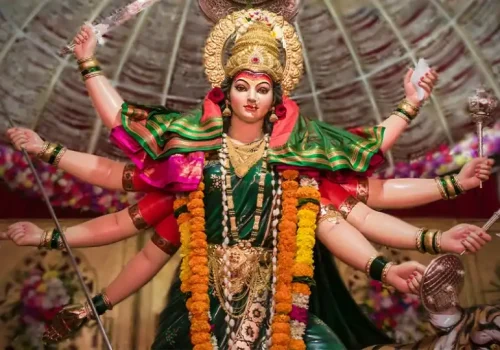
Durga Mata Chalisa -नमो नमो दुर्गे सुख करनी। नमो नमो दुर्गे दुःख हरनी॥ maa durga chalisa एक दिव्य स्तुति है जिसमें माता दुर्गा की शक्ति, कृपा और संरक्षण की प्रार्थना की जाती है। इस पाठ से भक्तजन के जीवन में साहस, सकारात्मक ऊर्जा और आध्यात्मिक शांति का अनुभव होता है। ऐसा माना जाता है कि Durga Mata Chalisa का नियमित पाठ करने से माता दुर्गा की अनंत कृपा प्राप्त होती है और जीवन की सभी बाधाएँ दूर होती हैं। Read Durga Mata Chalisa in Hindi.

Durga Mata Chalisa | Durga Chalisa in Hindi
नमो नमो दुर्गे सुख करनी।
नमो नमो दुर्गे दुःख हरनी॥
निरंकार है ज्योति तुम्हारी। तिहूं लोक फैली उजियारी॥
शशि ललाट मुख महाविशाला। नेत्र लाल भृकुटि विकराला॥
रूप मातु को अधिक सुहावे। दरश करत जन अति सुख पावे॥
तुम संसार शक्ति लै कीना। पालन हेतु अन्न धन दीना॥
अन्नपूर्णा हुई जग पाला। तुम ही आदि सुन्दरी बाला॥
प्रलयकाल सब नाशन हारी। तुम गौरी शिवशंकर प्यारी॥
शिव योगी तुम्हरे गुण गावें। ब्रह्मा विष्णु तुम्हें नित ध्यावें॥
रूप सरस्वती को तुम धारा। दे सुबुद्धि ऋषि मुनिन उबारा॥
धरयो रूप नरसिंह को अम्बा। परगट भई फाड़कर खम्बा॥
रक्षा करि प्रह्लाद बचायो। हिरण्याक्ष को स्वर्ग पठायो॥
लक्ष्मी रूप धरो जग माहीं। श्री नारायण अंग समाहीं॥
क्षीरसिन्धु में करत विलासा। दयासिन्धु दीजै मन आसा॥
हिंगलाज में तुम्हीं भवानी। महिमा अमित न जात बखानी॥
मातंगी अरु धूमावति माता। भुवनेश्वरी बगला सुख दाता॥
श्री भैरव तारा जग तारिणी। छिन्न भाल भव दुःख निवारिणी॥
केहरि वाहन सोह भवानी। लांगुर वीर चलत अगवानी॥
कर में खप्पर खड्ग विराजै। जाको देख काल डर भाजै॥
सोहै अस्त्र और त्रिशूला। जाते उठत शत्रु हिय शूला॥
नगरकोट में तुम्हीं विराजत। तिहुँलोक में डंका बाजत॥
शुम्भ निशुम्भ दानव तुम मारे। रक्तन बीज शंखन संहारे॥
महिषासुर नृप अति अभिमानी। जेहि अघ भार मही अकुलानी॥
रूप कराल कालिका धारा। सेन सहित तुम तिहि संहारा॥
परी गाढ़ सन्तन पर जब जब। भई सहाय मातु तुम तब तब॥
आभा पुरी अरु बासव लोका। तब महिमा सब रहें अशोका॥
ज्वाला में है ज्योति तुम्हारी। तुम्हें सदा पूजें नर-नारी॥
प्रेम भक्ति से जो यश गावें। दुःख दारिद्र निकट नहिं आवें॥
ध्यावे तुम्हें जो नर मन लाई। जन्म-मरण ताकौ छुटि जाई॥
जोगी सुर मुनि कहत पुकारी। योग न हो बिन शक्ति तुम्हारी॥
शंकर आचारज तप कीनो। काम क्रोध जीति सब लीनो॥
निशिदिन ध्यान धरो शंकर को। काहु काल नहिं सुमिरो तुमको॥
शक्ति रूप का मरम न पायो। शक्ति गई तब मन पछितायो॥
शरणागत हुई कीर्ति बखानी। जय जय जय जगदम्ब भवानी॥
भई प्रसन्न आदि जगदम्बा। दई शक्ति नहिं कीन विलम्बा॥
मोको मातु कष्ट अति घेरो। तुम बिन कौन हरै दुःख मेरो॥
आशा तृष्णा निपट सतावें। रिपु मुरख मोही डरपावे॥
शत्रु नाश कीजै महारानी। सुमिरौं इकचित तुम्हें भवानी॥
करो कृपा हे मातु दयाला। ऋद्धि-सिद्धि दै करहु निहाला।।
जब लगि जियऊं दया फल पाऊं। तुम्हरो यश मैं सदा सुनाऊं॥
श्री दुर्गा चालीसा जो कोई गावै। सब सुख भोग परमपद पावै॥
देवीदास शरण निज जानी। करहु कृपा जगदम्ब भवानी॥
॥इति श्रीदुर्गा चालीसा सम्पूर्ण॥
जय माता दी
Also read: Durga Mata Aarti
Written by: This is a widely recited traditional composition (Loka-Rachna) with an unknown author. It serves as a concise summary of the key concepts and stories found in the Devi Mahatmyam (Markandeya Purana).
Presented By: Mukti Mantra
The Deeper Meaning Behind Durga Mata Chalisa
The Durga Mata Chalisa is a heartfelt hymn dedicated to Maa Durga, the divine mother who provides strength, courage, and protection. Each verse celebrates her as both fierce and compassionate. She not only destroys negativity but also nurtures the universe with unconditional love. The Chalisa holds many profound spiritual truths about Maa Durga. The deeper essence of these teachings is discussed below:
The Chalisa’s Affirmation of Adi Shakti:
The verse “Tum sansar shakti lai keena, paalan hetu ann dhan deena” in the Durga Mata Chalisa declares Maa Durga not just as a goddess but the very power through which the universe came into existence. She is the creator, sustainer and nurturer of the entire world. The line ‘Tum hi aadhi sundari bala’ further expands this thought, affirming Durga as Adi Shakti, the very source of all energies.
In Shakti Philosophy, Devi Adi Shakti is not a creation but the force from which all creation comes into existence. In simple essence, this line reminds us that Maa Durga is both the cosmic force that created life and the divine mother who continually nourishes it. She provides energy, food, strength and abundance so that all beings can live, grow and fulfil their purpose.
Adi Shakti and Her Many Forms
As the Chalisa affirms her as the Adi Shakti, throughout the Durga Mata Chalisa she is described in various forms, each illustrating how the same eternal Shakti manifests as knowledge, prosperity, courage, motherhood and stands as a fierce protector.
She is praised as Sarawati, the giver of wisdom and as Lakshmi, the bestower of wealth and abundance. As Annapurna, she nourishes and sustains all forms of life. The Chalisa also celebrates her fierce and protective manifestation as Narsimha, tearing apart darkness to save the innocent. She is adored as Tripura Sundari, the eternal beauty and the supreme Shakti and is also called Hinglaj Bhavani, the one whose power is beyond description.
Her other subtle and wonderful forms, like Dhoomavati, Bhuvneshwari, Tara, and Jwala Devi, are also described. Ultimately, she is worshipped as Jagdamba, the mother of the entire universe. Through these multiple identities, Chalisa teaches that all Gods and Goddesses are expressions of one eternal shakti, Maa Durga herself.
Maa Durga as the Protector of Devotees
Durga Mata Chalisa also affirms that Maa Durga not only provides outer protection but also inner protection to her devotees. She blesses devotees with mastery over their own impulses, such as Kaam (lust) and Krodh(anger). She doesn’t remove just the enemies outside but also the enemies within, guiding devotees toward purity, clarity, and strength of character.
Her fierce forms, such as Kaalratri, Chandi and Narsinghi, are not meant to invoke fear, but to remind us that the same mother who destroys demons also destroys the inner demon we struggle with daily.
When she slays Mahishasura, it symbolises the destruction of stubborn ego; when she defeats Shumbh-Nishumbh, it reflects triumph over self-doubt and inner conflict.
Through every victory, she teaches the devotee that divine protection is not just about safety, it is also about upliftment, transformation and awakening the strength already within us.
Yogic and Spiritual Awakening through Shakti
The lines “Yogi Sur Muni kahat pukari, Yog na ho bin Shakti tumhari” provide a philosophical insight. It states that even Yogis and Sages proclaim that without Shakti, the spiritual union is impossible.
Here, Shakti refers to the divine energy within the human body, mostly known as Kundalini. The Durga Mata Chalisa states that we do not achieve spiritual progress only through intellect but also through the awakening of inner divine power.
Here, the chalisa encourages the devotee not only to seek outer protection but also to awaken inner strength, clarity and spiritual stability. Maa Duga becomes both the goal and the guide of the devotee’s spiritual journey.
Shiv Priya and Revered by the Trinity
The Chalisa lovingly calls her the beloved of Lord Shiva in the line “Tum Gauri Shiv Shankar Pyaari.” She is not only his consort but also the inner power that completes him. Without Shakti, Shiva is pure stillness, and without Shiva, Shakti has no direction.
The line “Shiv Yogi tumhare gun gave, Brahma Vishnu tumhe nit dhyave” further says that even Brahma and Vishnu pray to her daily. It is through her energy that Brahma creates, Vishnu preserves, and Shiva destroys.
According to Shaktism, everything that moves, breathes, shines, grows or transforms is Durga’s energy manifesting in different forms. She is present in the tiniest grain of food that nourishes us, in every breath, in the heartbeat and also in the ability to think, work, feel and create.
This divine Shakti within the human body is known as Kundalini energy. When awakened through devotion, discipline and purity, this Kundalini energy rises through the seven Chakras in the human body, taking one towards the ultimate reunion with the divine.
How to Read Durga Mata Chalisa Correctly
Reciting the Durga Mata Chalisa brings peace, strength, and divine blessings. When done with faith and the right preparation, it helps you to connect deeply with Maa Durga’s energy and invoke her protection and grace. Therefore, understanding how to read the Durga Mata Chalisa correctly is essential for fully receiving these blessings.
Preparation and Reading the Durga Mata Chalisa
- Cleanliness: Start by taking a bath to cleanse your body and wear fresh, clean clothes. A clean body helps create a clear mind.
- Setting the Space: Clean the area where you will read the Chalisa. Create a peaceful, sacred environment that is free from distractions.
- Offerings to the Goddess: Place flowers, rice (akshat), vermilion (roli), and sweets (prasad) in front of a picture or idol of Maa Durga as offerings.
- Lighting the Diya: Light a lamp (diya) to symbolise divine light and chase away negativity from the surroundings.
- Posture: Sit calmly in front of the image or yantra of Goddess Durga with a peaceful and focused mind.
- Focus: Chant the Chalisa slowly and clearly. Concentrate on the meaning of each verse to strengthen your connection with the Goddess.
- Direction: Face east or any lucky direction while reading. This attracts positive energy and divine blessings.
Best Time to Recite Durga Mata Chalisa
Daily Morning & Evening: Reading the Durga Mata Chalisa every day brings mental peace, courage, and spiritual balance. Morning and Evening are considered the best times to chant because the mind is calm and the atmosphere is pure.
During Navratri: The nine days of Navratri are especially strong for the worship of Durga Maa. Reciting the Chalisa during this time increases its benefits and draws the Goddess’s special blessings.
After completing the Chalisa, it is best to follow it with Durga Mata Aarti
Know more about Durga Maa
Here are some common questions people often have about Goddess Durga after reading Durga Mata Chalisa
Durga Mata’s vahan (vehicle), the lion, represents strength, courage, and control over powerful emotions. The lion also represents raw power and bravery. When it becomes the vehicle of the Goddess, it shows how she has complete command over even the fiercest forces of nature and human instincts.
According to legends, when Goddess Parvati was meditating, a fierce lion tried to attack her. But when she looked at him with love and compassion, he became calm and devoted to her, turning into her loyal companion. Lord Shiva later named him Somnandi. Some also believe that the lion was either a gift from her father, Himavan, or a defeated demon given to her by her son, Kartikeya.
The symbolism of the Gunas adds more depth to this meaning. The lion, with its wild and powerful energy, represents Rajo Guna (Passion and Action). The Goddess skillfully controls this energy and directs it toward Satva Guna (Goodness and Dharma). Therefore, Durga riding a lion symbolises her divine power (Shakti), her fearlessness, and the triumph of good over evil. It also demonstrates that true strength comes from love, self-control, and righteousness.
Mata Durga was not born in the usual way. She is believed to be a form of Goddess Parvati, who took a fierce and mighty appearance to destroy the demon Mahishasura. Her birth story is described in the Devi Mahatmyam, which is part of the Markandeya Purana, one of the most important scriptures dedicated to the worship of the Divine Mother.
To aid her in this significant battle, the gods gave her their divine weapons. Shiva gave his trident, Vishnu his discus, Indra his thunderbolt, Vayu his bow and arrows, Agni his spear, and other gods also offered their weapons. These gifts adorned her ten arms, making her the ultimate symbol of Shakti (divine energy).
This fierce battle went on for nine straight days and nights, which we now celebrate as Navratri.
No, Maa Durga and Maa Kali are not the same, although both are powerful forms of the Supreme Goddess, Shakti. The key difference is their relationship to time: Durga acts within time and space to maintain cosmic order and protect the universe, while Kali is the destructive power that exists outside of time (Mahakali), liberating the soul from the cycles of illusion and decay. Durga preserves and protects; Kali ultimately dissolves for final realisation.
Maa Durga represents courage, protection, and the balanced use of power, while Maa Kali embodies fierce, destructive energy that wipes out all evil. Together, they reveal the full cycle of creation, preservation, and dissolution governed by the Divine Feminine.
Goddess Durga is often depicted with ten arms, although she can also appear with eight or more. The ten-armed form is the most recognised. It symbolises her power over the ten directions: north, south, east, west, northeast, northwest, southeast, southwest, above, and below. Each arm holds a weapon or mudra, which has its own special meaning. This reflects her divine abilities and total control over the universe.
There are four Navratris each year: Chaitra Navratri, Sharad Navratri, and two Gupt Navratris, Magha and Ashadha. People celebrate Chaitra and Sharad Navratris widely with lively dances, gatherings, and community events. In contrast, the Gupt Navratris, Magha and Ashadha, are observed more privately. These periods focus on personal spiritual growth through meditation, fasting, and other devotional practices.
Spiritually, the visible Navratris, Chaitra and Sharad, represent the outer worship of the Divine Mother. This is celebrated through rituals and community devotion. The Gupt Navratris, in contrast, symbolise the inner worship. They reflect the quiet journey of self-realisation and the struggle against inner demons such as ego, anger, and desire. Together, all four Navratris remind devotees that true devotion comes from balancing the external celebration of divinity with the inner transformation of the soul.
Durga Maa is known as Jagat Janani, meaning Mother of the Universe, because she is regarded as the first and supreme divine power (Adi Shakti). From her, all creation, including the gods, takes form and continues to exist. She is worshipped as the creator, protector, and destroyer of the world, which is why she is lovingly known as Jagadamba, the mother of all.
The Aarti of Durga Maa also praises this divine truth, calling upon her as the benevolent mother who nurtures and protects the entire universe.
Durga is also known as Kalyani (कल्याणी), meaning auspicious, beautiful, kind, and bringer of good fortune. The name reflects her divine nature as the source of happiness, prosperity, and well-being for all. As Kalyani, she blesses her devotees with peace, protection, and positive energy. This name links her to Goddess Parvati, highlighting her nurturing and compassionate side that cares for the welfare of the world.
Related Posts
- All Posts
- Aarti
- ashtakam
- Bhajan
- Chalisa
- Hanuman Chalisa
- Stotram
- Stuti
- Back
- Shiva
- Hanuman
- Shri Radha
- Durga
- Lakshmi
- Back
- Ganesh Ji
- Maha Lakshmi
- Lord Vishnu
- Durga Maa
- Shiva
- Back
- Krishna Bhajan
- Back
- Shri Radha
- Back
- Shri Ram
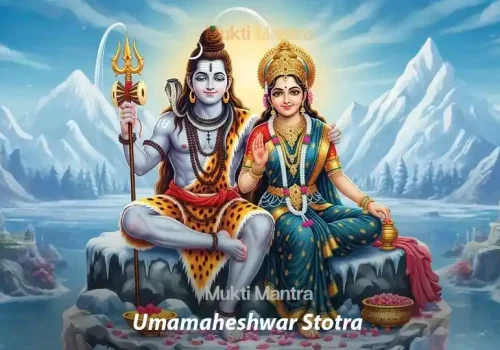
Umamaheshwar Stotra Lyrics | श्री उमा महेश्वर स्तोत्रं: नमः शिवाभ्यां नवयौवनाभ्यां परस्पराश्लिष्टवपुर्धराभ्याम् । नगेन्द्रकन्यावृषकेतनाभ्यां नमो नमः शङ्करपार्वतीभ्याम् ॥ Read full...
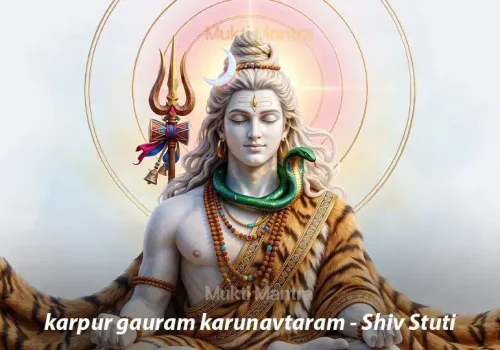
Karpur Gauram Karunavtaram Lyrics: Karpura-Gauram Karunavataram Samsara-Saram Bhujagendra-Haram || Read full Mantra with its word-by-word meaning below: Karpur Gauram Karunavtaram...
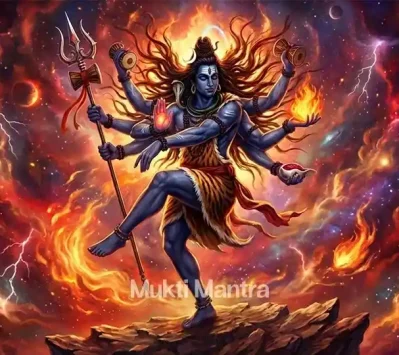
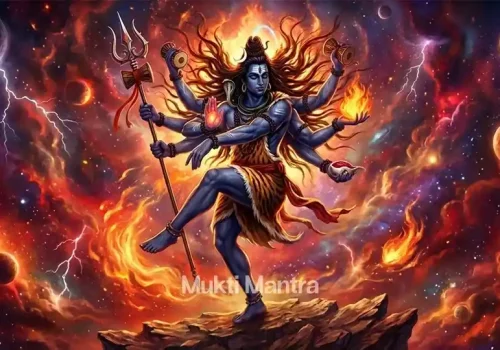
Shiv Tandav Stotram Lyrics in English: Jatāṭavī-gala-jjala-pravāha-pāvita-sthale Gale’valambya lambitāṃ | It is one of the most powerful and visually striking...