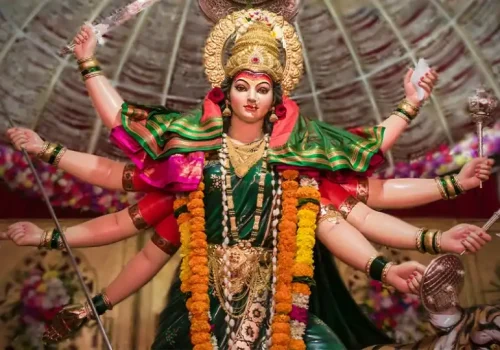
Ai Giri Nandini lyrics – aigiri nandini nandita medini viśva-vinodini nandanute girivara vindhya-śiroadhi-nivāsini viśhṇu-vilāsini jiśhṇunute | The Manhishasur Mardini Stotram is a powerful hymn dedicated to Maa Durga, praising her strength, beauty, and compassion. Through rhythmic verses, it celebrates her as the divine force who protects the universe, destroys evil, and guides devotees toward peace and surrender. Read its lyrics and complete meaning below:
Mahishasura Mardini Stotram (ai giri nandini lyrics)
aigiri nandini nandita medini viśva-vinodini nandanute
girivara vindhya-śiroadhi-nivāsini viśhṇu-vilāsini jiśhṇunute |
bhagavati he śitikaṇṭha-kuṭumbiṇi bhūrikuṭumbiṇi bhūrikṛte
jaya jaya he mahiśhāsura-mardini ramyakapardini śailasute ‖ 1 ‖
suravara-harśhiṇi durdhara-dharśhiṇi durmukha-marśhiṇi harśharate
tribhuvana-pośhiṇi śaṅkara-tośhiṇi kalmaśha-mośhiṇi ghośharate |
danuja-nirośhiṇi ditisuta-rośhiṇi durmada-śośhiṇi sindhusute
jaya jaya he mahiśhāsura-mardini ramyakapardini śailasute ‖ 2 ‖
ayi jagadamba madamba kadambavana-priyavāsini hāsarate
śikhari-śiromaṇi tuṅa-himālaya-śṛṅganijālaya-madhyagate |
madhumadhure madhu-kaitabha-gañjini kaitabha-bhañjini rāsarate
jaya jaya he mahiśhāsura-mardini ramyakapardini śailasute ‖ 3 ‖
ayi śatakhaṇḍa-vikhaṇḍita-ruṇḍa-vituṇḍita-śuṇḍa-gajādhipate
ripu-gaja-gaṇḍa-vidāraṇa-chaṇḍaparākrama-śauṇḍa-mṛgādhipate |
nija-bhujadaṇḍa-nipāṭita-chaṇḍa-nipāṭita-muṇḍa-bhaṭādhipate
jaya jaya he mahiśhāsura-mardini ramyakapardini śailasute ‖ 4 ‖
ayi raṇadurmada-śatru-vadhodita-durdhara-nirjara-śakti-bhṛte
chatura-vichāra-dhurīṇa-mahāśaya-dūta-kṛta-pramathādhipate |
durita-durīha-durāśaya-durmati-dānava-dūta-kṛtāntamate
jaya jaya he mahiśhāsura-mardini ramyakapardini śailasute ‖ 5 ‖
ayi nija huṅkṛtimātra-nirākṛta-dhūmravilochana-dhūmraśate
samara-viśośhita-śoṇitabīja-samudbhavaśoṇita-bīja-late |
śiva-śiva-śumbhaniśumbha-mahāhava-tarpita-bhūtapiśācha-pate
jaya jaya he mahiśhāsura-mardini ramyakapardini śailasute ‖ 6 ‖
dhanuranusaṅgaraṇa-kśhaṇa-saṅga-parisphuradaṅga-naṭatkaṭake
kanaka-piśaṅga-pṛśhatka-niśhaṅga-rasadbhaṭa-śṛṅga-hatāvaṭuke |
kṛta-chaturaṅga-balakśhiti-raṅga-ghaṭad-bahuraṅga-raṭad-baṭuke
jaya jaya he mahiśhāsura-mardini ramyakapardini śailasute ‖ 7 ‖
ayi śaraṇāgata-vairivadhū-varavīravarābhaya-dāyikare
tribhuvanamastaka-śūla-virodhi-śirodhi-kṛtā’mala-śūlakare |
dumi-dumi-tāmara-dundubhi-nāda-maho-mukharīkṛta-diṅnikare
jaya jaya he mahiśhāsura-mardini ramyakapardini śailasute ‖ 8 ‖
suralalanā-tatatheyi-tatheyi-tathābhinayodara-nṛtya-rate
hāsavilāsa-hulāsa-mayipraṇa-tārtajanemita-premabhare |
dhimikiṭa-dhikkaṭa-dhikkaṭa-dhimidhvani-ghoramṛdaṅga-ninādarate
jaya jaya he mahiśhāsura-mardini ramyakapardini śailasute ‖ 9 ‖
jaya-jaya-japya-jaye-jaya-śabda-parastuti-tatpara-viśvanute
bhaṇa-bhaṇa-jhiñjhimi-jhiṅkṛta-nūpura-śiñjita-mohitabhūtapate |
naṭita-naṭārdha-naṭīnaṭa-nāyaka-nāṭakanāṭita-nāṭyarate
jaya jaya he mahiśhāsura-mardini ramyakapardini śailasute ‖ 10 ‖
ayi sumanaḥ sumanaḥ sumanaḥ sumanaḥ sumanohara kāntiyute
śritarajanīraja-nīraja-nīrajanī-rajanīkara-vaktravṛte |
sunayanavibhrama-rabhra-mara-bhramara-bhrama-rabhramarādhipate
jaya jaya he mahiśhāsura-mardini ramyakapardini śailasute ‖ 11 ‖
mahita-mahāhava-mallamatallika-mallita-rallaka-malla-rate
virachitavallika-pallika-mallika-jhillika-bhillika-vargavṛte |
sita-kṛtaphulla-samullasitā’ruṇa-tallaja-pallava-sallalite
jaya jaya he mahiśhāsura-mardini ramyakapardini śailasute ‖ 12 ‖
aviraḻa-gaṇḍagaḻan-mada-medura-matta-mataṅgajarāja-pate
tribhuvana-bhūśhaṇabhūta-kaḻānidhirūpa-payonidhirājasute |
ayi sudatījana-lālasa-mānasa-mohana-manmadharāja-sute
jaya jaya he mahiśhāsura-mardini ramyakapardini śailasute ‖ 13 ‖
kamaladaḻāmala-komala-kānti-kalākalitā’mala-bhālatale
sakala-vilāsakaḻā-nilayakrama-keḻikalat-kalahaṃsakule |
alikula-saṅkula-kuvalayamaṇḍala-mauḻimilad-vakulālikule
jaya jaya he mahiśhāsura-mardini ramyakapardini śailasute ‖ 14 ‖
kara-muraḻī-rava-vījita-kūjita-lajjita-kokila-mañjurute
milita-milinda-manohara-guñjita-rañjita-śailanikuñja-gate |
nijagaṇabhūta-mahāśabarīgaṇa-raṅgaṇa-sambhṛta-keḻitate
jaya jaya he mahiśhāsura-mardini ramyakapardini śailasute ‖ 15 ‖
kaṭitaṭa-pīta-dukūla-vichitra-mayūkha-tiraskṛta-chandraruche
praṇatasurāsura-mauḻimaṇisphurad-aṃśulasan-nakhasāndraruche |
jita-kanakāchalamauḻi-madorjita-nirjarakuñjara-kumbha-kuche
jaya jaya he mahiśhāsura-mardini ramyakapardini śailasute ‖ 16 ‖
vijita-sahasrakaraika-sahasrakaraika-sahasrakaraikanute
kṛta-suratāraka-saṅgara-tāraka saṅgara-tārakasūnu-sute |
suratha-samādhi-samāna-samādhi-samādhisamādhi-sujāta-rate
jaya jaya he mahiśhāsura-mardini ramyakapardini śailasute ‖ 17 ‖
padakamalaṃ karuṇānilaye varivasyati yoanudinaṃ na śive
ayi kamale kamalānilaye kamalānilayaḥ sa kathaṃ na bhavet |
tava padameva parampada-mityanuśīlayato mama kiṃ na śive
jaya jaya he mahiśhāsura-mardini ramyakapardini śailasute ‖ 18 ‖
kanakalasatkala-sindhujalairanuśhiñjati te guṇaraṅgabhuvaṃ
bhajati sa kiṃ nu śachīkuchakumbhata-taṭīpari-rambha-sukhānubhavaṃ |
tava charaṇaṃ śaraṇaṃ karavāṇi natāmaravāṇi nivāśi śivaṃ
jaya jaya he mahiśhāsura-mardini ramyakapardini śailasute ‖ 19 ‖
tava vimaleandukalaṃ vadanendumalaṃ sakalaṃ nanu kūlayate
kimu puruhūta-purīndumukhī-sumukhībhirasau-vimukhī-kriyate |
mama tu mataṃ śivanāma-dhane bhavatī-kṛpayā kimuta kriyate
jaya jaya he mahiśhāsura-mardini ramyakapardini śailasute ‖ 20 ‖
ayi mayi dīnadayāḻutayā karuṇāparayā bhavitavyamume
ayi jagato jananī kṛpayāsi yathāsi tathānumitāsi rame |
yaduchitamatra bhavatyurarī kurutā-durutāpamapā-kurute
jaya jaya he mahiśhāsura-mardini ramyakapardini śailasute ‖ 21 ‖
Ithi Sri Mahishasura mardini stotram ||
Written by: Adi Shankaracharya
Presented By: Mukti Mantra
The Deeper Meaning Behind Ai Giri Nandini Lyrics
The Ai giri nandini lyrics are written in the Śravaṇabharaṇam poetic meter, with 92 syllables arranged in a steady, rhythmic pattern, making it powerful and energetic to recite. Through its verses, the Mahishasura Mardini Stotram takes us on a spiritual journey. It starts by describing Maa Durga as the source of all creation, then praising her fierce and warrior forms. It then moves to praising her beauty and compassion, and ends by expressing the bhava of Complete surrender and nishkam bhakti at her feet. Below, we discuss the deeper meaning each verse of this stotram holds:
Maa Durga as Cosmic Joy and Supreme Power
The opening verses of Ai Giri Nandini Lyrics introduce Maa Durga as the very source of joy, order, and power that sustains the universe. She is addressed as “Aigiri Nandini, Nandita Medini”, the daughter of mountains whose presence delights the earth itself. Her birth from mountains symbolises her unshakable strength, while “Viśva-vinodini” establishes her as the cosmic force that brings harmony, rhythm, and joy to all creation.
By calling her “Viṣṇu-vilāsini”, the stotra reveals that she is the active shakti through which Lord Vishnu sustains the entire creation. At the same time, “Girivara Vindhya-śiro-adhi-nivāsini” tells that she resides on the highest peaks of mountains. She is worshipped by celestial beings and is admired by Nandikeshwara himself, showing that even divine beings bow to Shakti as their source.
The hymn then reveals her as “Bhagavati he Śitikaṇṭha-Kuṭumbiṇi”, meaning the beloved consort of Lord Shiva, presenting the eternal balance of pure consciousness (Shiva) with active power (Shakti). As “Bhūri-Kuṭumbiṇi”, she is not limited to a single form or role, but stands as the universal mother with a vast cosmic family, nurturing gods, humans, and others.
The Fierce and Nurturing Nature of Maa Durga
The second verse expands this vision by revealing how the same loving, nourishing power also manifests as fierce protection. As “Suravara-harśhiṇi”, she brings reassurance and joy to the gods, restoring balance wherever righteousness trembles. She fearlessly faces forces that are difficult to restrain and corrects arrogance wherever it arises. Her happiness comes from the restoration of cosmic harmony as described in the line “durdhara-dharśhiṇi durmukha-marśhiṇi harśharate”.
She is described as “Tribhuvana-pośhiṇi”, the nourisher of all three worlds, sustaining life at every level of existence. The verse also affirms her connection with Lord Shiva through “Śaṅkara-tośhiṇi”, showing that when Shakti acts in alignment with consciousness, the universe remains in balance.
Through names like “Danuja-nirośhiṇi,” “Ditisuta-rośhiṇi,” and “Durmada-śośhiṇi,” she emerges as the power that dissolves ego, rage, and pride. She is called “Sindhu-sute”, the daughter of the ocean, symbolising depth, vastness, and unfathomable strength.
Maa Durga as Jagadambā, the Universal Mother
The third verse turns the devotee’s gaze towards Maa Durga as Jagadambā, whose presence is both nurturing and supremely powerful and embodies boundless maternal compassion as addressed in the phrase “Ayi Jagadamba, Madamba”.
She delights in residing among Kadamba trees that are symbols of natural harmony as described in the line “Kadamba-vana-priya-vāsinī”. In contrast to this, she is also “Śikhari-śiromaṇi tuṅga-Himālaya-śṛṅga-nija-ālaya-madhya-gate,” residing among the highest himalyan peaks, the crown of all mountains. This contrast beautifully establishes her equally present in the quiet forest grove and loftiest heights of consciousness.
The verse further reveals her inner essence as “Madhu-madhure,” meaning the one who is supremely sweet and enchanting. She finds delight in “Rāsa-rate,” the divine cycle of creation, preservation, and transformation. Yet, this gentle, ever-smiling mother is also the fierce force behind the defeat of demons. Through “Madhu-Kaitabha-gañjinī” and “Kaitabha-bhañjinī,” the stotram calls her the Slayer of the demons Madhu and Kaitabha and the destroyer of evil forces.
Maa Durga as the Fierce Warrior and Invincible Protector of Dharma
Verses 4-6 reveal the same divine mother in an unstoppable, fierce form. Described as “śatakhaṇḍa-vikhaṇḍita”, she shatters the arrogance of her enemies and reduces even the mightiest forces to insignificance. She rides the fierce lion “mṛgādhipate,” and tears apart demonic pride symbolised as war elephants, asserting that no strength can stand against her divine will.
Her power only intensifies on the battlefield. She directs even Shiva as her messenger, “dūta-kṛta-pramathādhipate,” establishing Shakti as the ultimate authority in the restoration of dharma. She destroys not only demon kings but also their corrupt intentions and messengers, cutting off evil at its source.
Through “nija huṅkṛtimātra-nirākṛta,” the stotram declares that at the height of her fury, even her roar becomes a weapon powerful enough to destroy demons entirely. On the battlefield, she, in her form as Kali, dries up the very source of recurring evil as “Śoṇita-bīja-late,” destroying Raktabīja by preventing his blood from giving rise to new demons.
In the great war against Śumbha and Niśumbha, “Śiva Śiva Śumbha-niśumbha-mahāhava,” her fury is so heightened that she becomes like a blazing sun, ignited by the thunder of divine drums, holding the trident that signifies her mastery over the three worlds, addressing her as “tribhuvani”. She protects those who surrender and terrifies those who resist truth.
Maa Durga as the Dynamic Force of Battle
In verses 7 and 8, Maa Durga appears as a living storm on the battlefield. As “dhanur-anusaṅgaraṇa… pari-sphurat-aṅga-naṭat,” she strings her bow and moves with lightning speed, her limbs flashing as she dances through war. Battle becomes her stage, “kṣhiti-raṅga,” where her every motion carries precision and purpose. Armed with glowing arrows and a resonant quiver, “kanaka-piśaṅga-pṛśhatka-niśhaṅga,” she strikes down the pride and power of enemy warriors in a single moment.
Her force multiplies in all directions as “kṛta-chaturaṅga-bala,” making demons like Dhūmralocana dissolve into smoke. Yet amidst this fury, she remains radiant, fierce, and beautiful, standing in harmony with Lord Shiva and her celestial companions.
Verse eight reveals her deeper compassion beneath this fearsome form. As “śaraṇāgata… abhaya-dāyikare,” she grants refuge to those who come seeking protection, including the families of fallen enemies. She holds the trishul, “tri-bhuvana-mastaka-śūla-kare,” facing it towards the heads of her enemies, and as tribhuvani, shows her complete authority over the three worlds.
The cosmic rhythm of drums, “dundubhi-nāda,” fills all directions, announcing her victory, the triumph of dharma.
Playfulness, Dance, and Glory of Maa Durga
In verse 9, the Ai Giri Nandini lyrics gently move from describing Maa Durga’s fierce energy to her playful and graceful presence. She delights in the dance of the celestial maidens, “sura-lalanā… nṛtya-rate,” enjoying their movements.
She is filled with laughter, playfulness, and happiness, “hāsa-vilāsa-hulāsa-mayī.” When devotees bow before her with surrender, she fills hearts with warmth and love. The powerful sound of the sacred drum “ghora mṛdaṅga-nināda” pleases her, and its rhythm spreads joy in all directions.
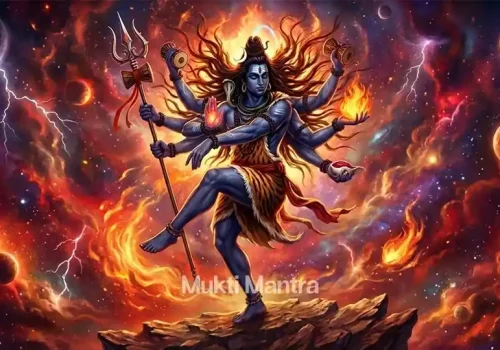
In Verse 10, the lyrics of Ai giri nandini celebrae Maa Durga as the one whose glory fills the entire universe. Her name is repeatedly chanted with cries of victory, “jaya jaya,” and people are praising her everywhere. The sweet rhythmic sound of her anklets, “nūpura-śiñjita,” captivates even Lod Shiva. As Natraja and Shakti, they perform the cosmic dance, tandav, together.
Perfect Balance of Beauty and Strength
In verse eleven, the Mahishasura Mardini Stotram celebrates Maa Durga’s beauty. By repeating “sumanaḥ” again and again, the hymn emphasises that she attracts those with good hearts and clean intentions. Her beauty, “sumanohara kānti-yute,” is radiant yet gentle.
She is described as both the night and the moon within it. As “rajanī”, she represents the calm, silent darkness while her face shines like the moon, “rajanīkara-vaktra-vṛte”. Her eyes, described as “sunayana-vibhrama,” move with such grace that they resemble bees softly circling a flower.
Verse twelve illustrates how her beauty and power coexist in perfect balance. She finds delight in overcoming even the strongest and most arrogant warriors, “mahita-mahāhava-malla-rate,” reminding us that softness and strength are not opposites when it comes to divine power.
Her form shines with blooming white flowers and fresh reddish leaves as described in Ai Giri Nandini lyrics, “sita-kṛtaphulla… aruṇa-pallava,” symbolising purity and fresh energy.
Supreme Beauty of Maa Durga described in the Ai Giri Nandini lyrics
In verse thirteen, the Mahishasura Mardini Stotram tells about Maa Durga’s majestic and captivating presence. Her movement carries the power and grace of a royal elephant in full strength in the lines “aviraḻa… mataṅgajarāja-pate”. She is described as the very ornament of the three worlds, “tribhuvana-bhūśhaṇa-bhūta,” whose beauty enriches all creation.
Her beauty is so powerful that it enchants even Manmatha, the god of love, who himself controls desire and attraction. This is conveyed in the line “mānasa-mohana-manmatha-rāja-sute,” of the Ai giri Nandini lyrics.
The fourteenth verse uses poetic imagery to further describe her divine beauty. Her forehead glows softly like a pure lotus petal, “kamala-daḻāmala-komala-kānti,” radiating calm and spiritual beauty. The stotram further states that she is the source of all forms of art and expression in the line “sakala-vilāsa-kalā-nilaya”. She moves with natural harmony like a group of swans gliding on water. Her hair is adorned like a garden of lotuses surrounded by humming bees, beautifully expressed in the line “alikula-saṅkula-kuvalaya-maṇḍala,” further elevating the imagery of her living beauty.
The Goddess as the Source of Divine Music and Light
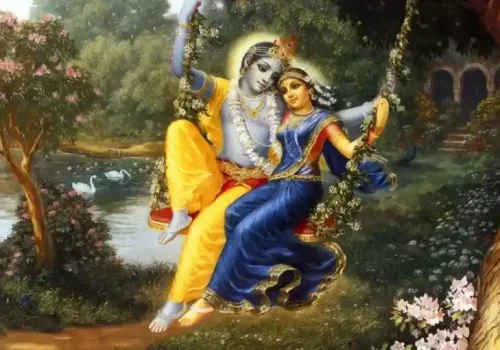
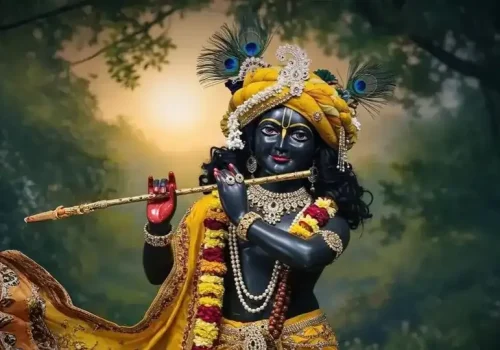
Verse 15 in the Ai giri nandini lyrics describes how sweet a sound like that of a flute, also known as Murli, emerges from her hand in the line “kara-muraḻī-rava-vījita-kūjita-lajjita-kokila-mañjurute” that even the Koyal bird, known for its sweet voice, is moved. According to Devi Puran, Krishna is considered an incarnation of Kali, adding significance to Devi holding and playing the flute in these verses. It also reinforces the belief that Maa Durga, as Shakti, is the ultimate source of all divine beings.
As she moves through mountain groves “milita-milinda-manohara-guñjita-rañjita-śailanikuñja-gate”, bees gather and hum in delight, and the forest comes alive. The verses then deepen this vision through “nijagaṇabhūta-mahāśabarīgaṇa-raṅgaṇa-sambhṛta-keḻitate”, where she moves joyfully among her own attendants and forest beings.
Moving forward, verse 16 shifts the focus to the physical radiance that emerges from the goddesses. The golden silk at her waist, described as “kaṭitaṭa-pīta-dukūla…tiraskṛta-chandraruche”, outshines even the moon. It shows that in front of her inner tej, her conscious energy and aura, even the moon appears pale.
The hymn further magnifies her sovereignty through the lines “praṇatasurāsura-mauḻimaṇi…nakhasāndraruche”, where gods and demons bow at her feet. The light reflected from their jewelled crowns intensifies the glow of her nails, making them shine like moonlight.
The Mother Who Grants both Victory and Wisdom
Verse 17 opens with “vijita-sahasrakaraika-sahasrakaraikanute”, declaring that her brilliance surpasses even the thousand-rayed sun. She is also praised as the divine mother who enabled the destruction of the demon Tāraka through her son, Kartikeya, also known as Skanda, in the lines “kṛta-suratāraka-saṅgara…tāraka-sūnu-sute”.
The lines “suratha-samādhi-samāna-samādhi…sujāta-rate” tell that she is worshipped by the greatest sages like Suratha. According to Devi Mahatmyam, King Suratha, after losing his kingdom, sought guidance from the sage Medhas (or Medha) to understand his sufferings and worshipped Goddess Durga to regain his kingdom and attain spiritual liberation.
As Mahiśhāsura-mardini, Maa Durga continues to destroy the forces that obstruct harmony, yet as Ramyakapardini Śailasute, she remains intimately accessible to those who seek her with humility and focus.
Complete Surrender at the Feet of Maa Durga
The final verses of Ai giri nandini lyrics guide the devotee towards complete surrender at the feet of Maa Durga. The hymn describes that whoever worships her lotus-like feet and recognises her feet as param-pada, the highest goal itself, Maa Durga, being the embodiment of compassion and auspiciousness herself, endows them with prosperity. Here, prosperity is not only confined to material prosperity but also to spiritual prosperity. This bhav is conveyed in the line “pada-kamalam karuṇā-nilaye” in the stotram.
It is further said that a true devotee constantly remembers Maa Durga, and this is expressed in the line “kanakalasatkala-sindhujalair anuśhiñjati te guṇaraṅgabhuvaṃ”. The sprinkling of golden ocean-like water is not a physical act, but rather symbolises pure devotion and loving remembrance of her greatness. Such a devotee who remains absorbed in her naturally loses interest in worldly or heavenly pleasures, even those enjoyed by Indra, as mentioned in “bhajati sa kiṃ nu…”. Real fulfilment arises only from surrender, which is why the devotee finally seeks refuge only at her feet in “tava charaṇaṃ śaraṇaṃ karavāṇi”.
Finding Peace at the Feet of Maa Durga
As the stotram progresses towards its conclusion, the devotee praises Maa Durga’s pure and calming beauty. When the Ai Giri Nandini lyrics say “tava vimala-indu-kalaṃ vadanendumalaṃ”, it describes her face as bright and gentle like the moon, which naturally brings peace to the mind. Due to this divine beauty and purity, the heart gradually loses interest in worldly attractions.
The line “kimu puruhūta-purī…” explains that even the pleasures and beautiful beings of Indra’s heavenly city feel insignificant before her presence. Further, in the line “mama tu mataṃ śiva-nāma-dhane”, it is said that devotion to Lord Shiva and Maa Parvati is the greatest treasure. When worshipped with full devotion, how could she not fulfil our wishes.
By saying “ayi mayi dīna-dayālutayā”, the devotee is asking her to look upon them with kindness and compassion. She is called “jagato jananī”, meaning the mother of the entire universe. Here, instead of asking for specific rewards, the devotee completely surrenders their fate, will, and worries at her feet and asks her to do whatever she feels is right with them, expressing sampooran samarpan and niskam bhakti.
Know more about Durga Maa
Here are some common questions people often have about Goddess Durga after reading the Mahishasura Mardini Stotram
The first form of Maa Durga is Maa Shailputri, the daughter of the Himalayas. She symbolises purity, strength, and stability, and is worshipped on the first of Navratri.
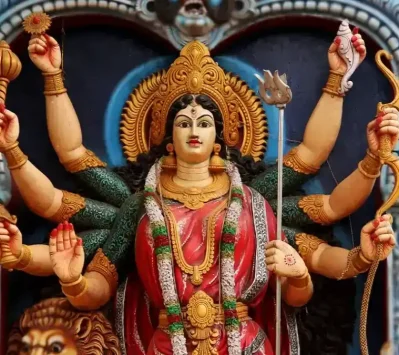
Maa Durga has three eyes and is referred to as Triyambake or Trinetri, meaning the three-eyed Goddess. Her left eye represents desire (the moon), her right eye represents action (the sun), and the central eye represents knowledge (fire) like Shiva.
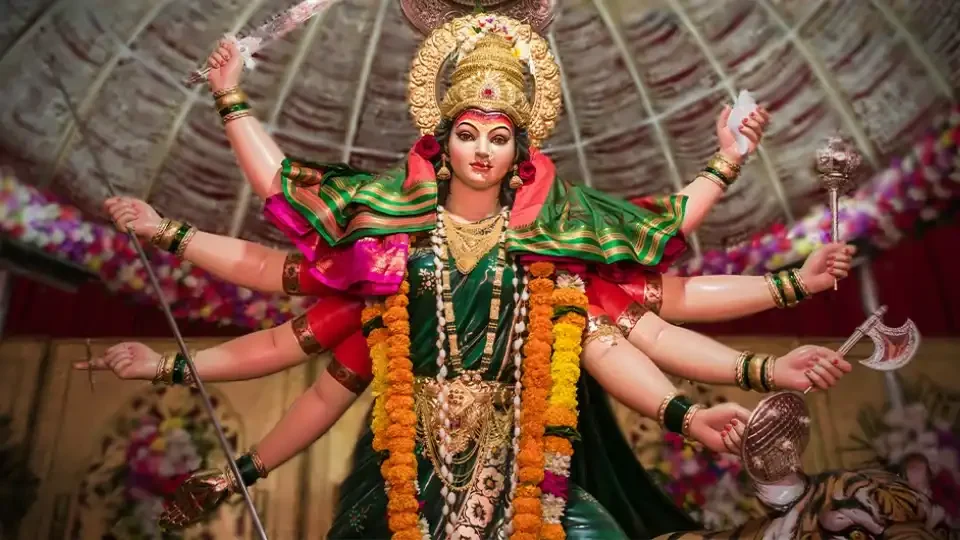
The gods collectively gave their divine weapons to Goddess Durga to empower her in the battle against Mahishasura. Shiva gave his trishul, Vishnu gave his Sudarshan-chakra, Indra gave his Vajra, Varuna gave his Shankha, and Yama gave his Sword. These weapons adorned Maa Durga's 10 arms and empowered her as the supreme force to fight Mahishasura.
Goddess Durga is often depicted as the mother of Lakshmi and Sarasvati, especially in Bengal during Durga Puja. However, some scriptures see them as other incarnations of the supreme goddess Adi Shakti. The Padma Purana mentions Ashok Sundari, daughter of Lord Shiva and Maa Parvati.
King Surath first worshipped Goddess Durga, as mentioned in the Devi Mahatmya. However, the grand public celebration of Durga Puja was started by Raja Kangsanarayan in the 16th-century Bengal.
Related Posts
- All Posts
- Aarti
- Bhajan
- Chalisa
- Stotram
- Stuti
- Back
- Shiva
- Hanuman
- Shri Radha
- Durga
- Lakshmi
- Back
- Ganesh Ji
- Maha Lakshmi
- Lord Vishnu
- Durga Maa
- Shiva
- Back
- Krishna Bhajan
- Back
- Shri Radha
- Back
- Shri Ram

Aarti of Lord Shiva: Om Jai Shiv Omkara is a sacred hymn that praises Lord Shiva, the destroyer of evil...
Durga Mata Chalisa -नमो नमो दुर्गे सुख करनी। नमो नमो दुर्गे दुःख हरनी॥ maa durga chalisa एक दिव्य स्तुति है...
Lord Shiva Chalisa: जय गिरिजा पति दीन दयाला। सदा करत संतन प्रतिपाला॥ शिव चालीसा (Shiva Chalisa Hindi) का पाठ करना...