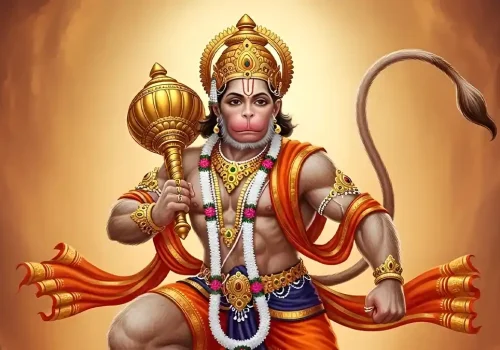
Hanuman Chalisa lyrics in English: Shri Guru Charan Saroja Raj, nij man mukur sudhaari, Barnaun Raghuvar bimal jasu, jo daayak phal chaari.
The Hanuman Chalisa, written by Goswami Tulsidas, is a powerful hymn of 40 verses that celebrates Lord Hanuman’s unmatched devotion to Lord Rama. It is rooted in Dāsya Bhāv, which embodies pure service, loyalty, and surrender. This sacred prayer teaches humility, strength, and unwavering faith. Here you can read the complete Hanuman Chalisa lyrics in English, learn about the story behind its writing, and find out interesting facts, such as how it mentions the distance between the Earth and the Sun.
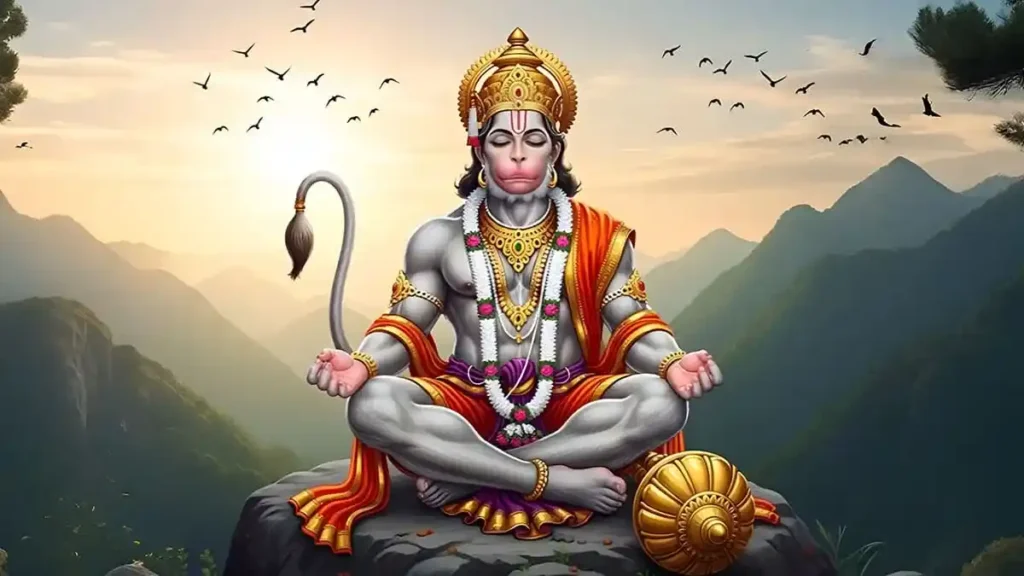
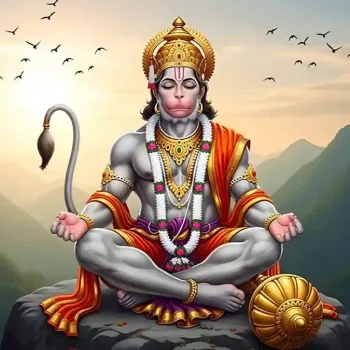
Hanuman Chalisa | Hanuman Chalisa Lyrics in English
Shri Ram Jai Ram Jai Jai Ram,
Shri Ram Jai Ram Jai Jai Ram,
Shri Ram Jai Ram Jai Jai Ram,
Shri Ram Jai Ram Jai Jai Ram…
Doha
Shri Guru Charan Saroja Raj, nij man mukur sudhaari,
Barnaun Raghuvar bimal jasu, jo daayak phal chaari.
Buddhi heen tanu jaanike, sumirau Pavan-Kumar,
Bal buddhi vidya dehu mohin, harahu kalesh vikaar.
Chaupai
Jai Hanuman gyaan gun saagar,
Jai Kapis tihun lok ujaagar.
Ram doot atulit bal dhaama,
Anjani-putra Pavan-sut naama.
Mahabeer bikram bajrangi,
Kumati nivaar sumati ke sangi.
Kanchan varan viraaj subesa,
Kanan kundal kunchit kesa.
Haath bajra aur dhwaja biraaje,
Kandhe moonj janeu saaje.
Shankar suvan Kesari nandan,
Tej pratap maha jag vandan.
Vidya vaan guni ati chatur,
Ram kaaj karibe ko aatur.
Prabhu charitra sunibe ko rasiya,
Ram Lakhan Sita man basiya.
Sookshma roop dhari Siyahi dikhawa,
Bikat roop dhari Lanka jarawa.
Bheem roop dhari asur sanhaare,
Ramchandra ke kaaj sanwaare.
Laaye Sanjeevan Lakhan jiyaaye,
Shri Raghubir harashi ur laaye.
Raghupati keenhi bahut badaai,
Tum mam priya Bharat hi sam bhai.
Sahas badan tumharo jas gaave,
As kahi Shripati kanth lagaave.
Sanakadik Brahmadik Munisa,
Narad Sarad sahit Ahisa.
Yam Kuber Digpaal jahan te,
Kavi kobid kahi sake kahan te.
Tum upkaar Sugrivahi keenha,
Ram milaye rajpad deenha.
Tumharo mantra Vibheeshan maana,
Lankeshwar bhaye sab jag jaana.
Jug sahasra yojan par Bhaanu,
Leelyo taahi madhur phal jaanu.
Prabhu mudrika meli mukh maahi,
Jaladhi langhi gaye acharaj naahi.
Durgam kaaj jagat ke jete,
Sugam anugrah tumhare tete.
Ram duaare tum rakhwaare,
Hot na aagya binu paisaare.
Sab sukh lahe tumhaari sarna,
Tum rakhshak kaahu ko darna.
Aapan tej samhaaro aapai,
Teeno lok haank te kaampai.
Bhoot pisaach nikat nahi aavai,
Mahabeer jab naam sunavai.
Naasai rog hare sab peera,
Japat nirantar Hanumat beera.
Sankat te Hanuman chhudaavai,
Man karam bachan dhyaan jo laavai.
Sab par Ram tapasvi raaja,
Tin ke kaaj sakal tum saaja.
Aur manorath jo koi laavai,
Sohi amit jeevan phal paavai.
Chaaro jug par taap tumhaara,
Hai prasiddh jagat ujiyaara.
Saadhu sant ke tum rakhwaare,
Asur nikandan Ram dulare.
Ashta siddhi nau nidhi ke daata,
As bar deen Janki maata.
Ram rasaayan tumhare paasaa,
Sada raho Raghupati ke daasa.
Tumhare bhajan Ram ko paavai,
Janam janam ke dukh bisraavai.
Ant kaal Raghubar pur jaayi,
Jahan janma Hari bhakt kahayi.
Aur devta chitt na dharai,
Hanumat sei sarb sukh karai.
Sankat katai mitai sab peera,
Jo sumirai Hanumat balbeera.
Jai Jai Jai Hanuman Gosai,
Kripa karahu Gurudev ki naai.
Jo sat baar paath kar koi,
Chhooti bandi maha sukh hoi.
Jo yah padhe Hanuman Chalisa,
Hoye siddhi saakhi Gaurisa.
Tulsi Das sada Hari chera,
Keejai Naath hriday mah dera.
Doha
Pavan tanay sankat haran, mangal moorat roop,
Ram Lakhan Sita sahit, hriday basahu sur bhoop.
Shri Ram Jai Ram Jai Jai Ram
Shri Ram Jai Ram Jai Jai Ram,
Shri Ram Jai Ram Jai Jai Ram,
Shri Ram Jai Ram Jai Jai Ram,
Shri Ram Jai Ram Jai Jai Ram…
Jai Shree Ram
Jai Veer Bajrangi
Namah Parvati Pataye Har Har Mahadev
Written by: Sant Tulsidas Ji
Presented By: Mukti Mantra
Why Should We Remember Shri Ram While Reading Hanuman Chalisa?
Before starting and after finishing the Hanuman Chalisa, devotees often remember Lord Rama by chanting “Shree Ram Jai Ram Jai Jai Ram.” It is believed that wherever people speak the name of Shri Ram or recite the Ramayana, Hanuman Ji is present there in spirit and devotion.
Know How Hanuman Chalisa Was Written in the Jail of a Mughal Emperor – Full Story
According to legend, Mughal Emperor Akbar once heard great praises of Tulsidas ji and invited him to his court. When Tulsidas ji refused, he was taken there by force. There, Akbar asked him to perform a miracle. Tulsidas ji humbly replied that he was not a magician, but simply a devoted follower of Lord Shri Ram.
Akbar then asked him to show the darshan of Shri Ram. Tulsidas ji explained that one can only attain Shri Ram’s darshan through pure devotion and a true heart (sach mann). Hearing this, Akbar grew angry and ordered him to be imprisoned.
While in prison at Fatehpur Sikri, Tulsidas ji wrote the Hanuman Chalisa and recited it with deep faith for 40 days. On the 40th day, a miracle occurred. An army of monkeys suddenly appeared, stormed the city, and caused such destruction that even the palace roofs began to collapse, damaging property and attacking people until the chaos became unbearable.
Realising this was the power of Tulsidas ji’s devotion, Akbar immediately released him and asked for forgiveness. Tulsidas ji then prayed to Hanuman Ji, and the monkeys disappeared as suddenly as they had come.
Know How Hanuman Chalisa Mentions the Distance Between the Sun and the Earth
The Hanuman Chalisa, written by the poet-saint Goswami Tulsidas in the 16th century, is a well-known devotional hymn. One of its verses is often cited as mentioning the distance between the Earth and the Sun with surprising accuracy.
The Verse
“जुग सहस्त्र जोजन पर भानु, लील्यो ताहि मधुर फल जानु।”
(Jug sahasra yojan par bhanu, leelyo taahi madhur phal jaanu.)
Meaning
The line describes how Lord Hanuman, as a child, mistook the Sun (Bhanu) for a sweet fruit (Madhur phal) and leapt towards it, even though it was far away — “Jug sahasra yojan par”, meaning “at a distance of several yojanas.”
Decoding the Distance
In ancient Indian measurements:
- 1 Yojan ≈ 8 miles (about 12.8 km)
- 1 Sahasra = 1,000
- 1 Jug (Yuga) = 12,000
When multiplied together:
12,000×1,000×8=96,000,000 miles
That equals around 153.6 million kilometres..
Scientific Comparison
Modern science estimates the average distance between the Earth and the Sun to be approximately 93 million miles, or around 150 million kilometres. The Hanuman Chalisa’s verse suggests this distance is about 96 million miles. This is surprisingly close to the scientific figure, even though the Chalisa was written hundreds of years before modern astronomy existed.
Interpretation:
Tulsidas Ji wrote this verse to describe a well-known incident from Hanuman Ji’s childhood. The story tells that Hanuman once saw the Sun shining brightly in the sky and thought it was a ripe fruit. Out of curiosity and playfulness, he jumped toward it, travelling across the skies to get there. The verse beautifully highlights the vast distance Hanuman covered, which, when calculated, closely matches the actual distance between the Earth and the Sun.
This verse also emphasises Hanuman’s unmatched strength and divine energy. The way the ancient Indian unit of distance (Yojan) matches today’s scientific understanding has fascinated both devotees and scholars for a long time. This interesting coincidence reminds us how faith, poetry, and knowledge often combine in India’s spiritual literature, mixing devotion with cosmic insight.
Know more about Hanuman Ji
Here are some common questions people often ask about Hanuman Ji after reading Hanuman Chalisa:
The most sacred time to recite the Hanuman Chalisa is Brahma Muhurta, which is between 4:00 and 5:30 am. During this time, the mind is calm, and the surroundings are full of positive energy. Additionally, reciting it at sunset or before going to sleep at night is also very beneficial. However, the Hanuman Chalisa can be recited at any time, and it will always be rewarding. While devotion at any hour is important, these specific times are thought to bring special blessings.
Hanuman Ji was born in Anjaneri (or Anjanipura), near Hampi in Karnataka, India. He is the son of Anjana and Kesari, and is considered an avatar of Lord Shiva. His mother, Anjana, prayed to Shiva for a son. Shiva granted her wish by being born as Hanuman, who was meant to serve Lord Rama with deep devotion. Many texts, including the Shiva Purana and Hanuman Chalisa, refer to him as “Shankar Suvan,” meaning son of Shiva.
His birthplace is a revered pilgrimage site, attracting devotees who come to seek his blessings and learn about the divine stories of his childhood.
Hanuman Ji's mother was Anjana (Añjanā). She was once a beautiful spirit (apsara) in Heaven named Punjikastala, who was cursed to be born on Earth as a vanara (monkey-like being). In this form, she married the vanara chief Kesari, and together they were blessed with the birth of Lord Hanuman.
This story also carries a deep lesson. If Mata Anjana had not been cursed to come to Earth, she would never have prayed to Lord Shiva for a son. As a result, she would not have become the mother of the mighty Hanuman. It reminds us that what seems like bad luck at first can lead us to something much greater and more beautiful.
The Panchmukhi Hanuman form combines the essence of Lord Hanuman with that of four other powerful incarnations linked to Lord Vishnu. In this form, Hanuman Ji has five faces. Each face represents a different power and direction. These are:
- Hanuman (East-facing) – courage, deep devotion, and immense strength.
- Narasimha (South-facing) – Protector against fear and evil forces.
- Garuda (West-facing) – Removes black magic, poison and negative energies.
- Varaha (North-facing) – Grants prosperity and protects from disasters.
- Hayagriva (Upward-facing) – Bestows knowledge, wisdom, and victory.
It is believed that worshipping Panchmukhi Hanuman brings comprehensive protection and blessings from every direction.
Interestingly, while Hanuman Ji is seen as an incarnation of Lord Shiva, his other four faces represent forms of Lord Vishnu. This divine unity beautifully illustrates the oneness of all gods and demonstrates that every force in the universe works in harmony for the greater good of dharma. It also reflects the essence of Dāsya Bhav; even in his strongest form, Hanuman Ji remains the devoted servant of Lord Rama, using his strength solely to serve his master.
No, Lord Hanuman is not traditionally considered to be married. He is widely known as a Bal Brahmachari, a lifelong celibate devoted to serving Shree Ram. However, some regional stories and texts, such as the Parashara Samhita, mention his marriage to Suvarchala Devi, the daughter of the Sun God, to gain special knowledge. However, this version is rare and not mentioned in Valmiki’s original Ramayana.
Lord Hanuman's son is Makardhwaja, an unusual figure in Hindu mythology. The story of his birth is detailed in the Ananda Ramayana and some other texts. After delivering Shri Ram’s message to Mata Sita in Lanka, Hanuman was on his way back when a drop of his sweat fell into the ocean. A fish swallowed this drop, and from it, and from it, Makardhwaja was born.
In later tales, Makardhwaja appears as a brave warrior who protected the gates of Patal Lok under the demon king Ahiravana.
Lord Hanuman is regarded as the epitome of celibacy and devotion. However, this tale symbolically reflects his divine energy rather than human procreation. Makardhwaja’s birth highlights the incredible strength of Hanuman Ji’s spiritual discipline. This story showcases the immense energy and divine power within Hanuman Ji. His strength is so great that even a single drop of his sweat could create a mighty warrior.
Hanuman had five brothers: Matiman, Shrutiman, Ketuman, Gatiman, and Dhritiman. They were the sons of his parents, Kesari and Anjani. All of them, except for the eldest, Hanuman, were married and had children.
Related Posts
- All Posts
- Aarti
- Bhajan
- Chalisa
- Stotram
- Stuti
- Back
- Shiva
- Hanuman
- Shri Radha
- Durga
- Lakshmi
- Back
- Ganesh Ji
- Maha Lakshmi
- Lord Vishnu
- Durga Maa
- Shiva
- Back
- Krishna Bhajan
- Back
- Shri Radha
- Back
- Shri Ram
Shiv Tandav Stotram Lyrics with meaning: Jatāṭavī-gala-jjala-pravāha-pāvita-sthale Gale’valambya lambitāṃ | It is one of the most powerful and visually striking...
Shri Ram Janki Lyrics: Shri Ram Janki baithe hai mere seene mein, is a deeply devotional composition that expresses unwavering faith...
The Ashutosh Shashank Shekhar Lyrics is a Stuti dedicated to Lord Shiva, praising him through powerful names that reflect his...