Lyrics of Aarti Kunj Bihari ki – Lord Krishna Aarti – आरती कुंजबिहारी की, श्री गिरिधर कृष्ण मुरारी की। यह आरती श्रीकृष्ण के सौंदर्य, करुणा और भक्तवत्सल स्वरूप का मधुर स्तवन है। यह आरती वृंदावन के कुंजों में विहार करने वाले, गिरिधर गोपाल के प्रति प्रेम, समर्पण और पूर्ण श्रद्धा का भाव व्यक्त करती है।
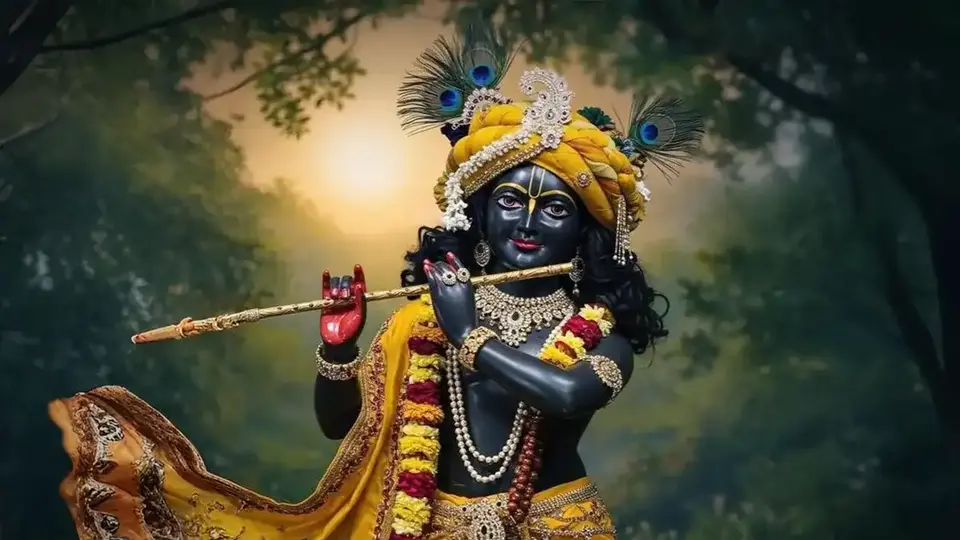
Lord Krishna Aarti - Lyrics of Aarti Kunj Bihari ki
आरती कुंजबिहारी की, श्री गिरिधर कृष्ण मुरारी की।
गले में बैजंती माला, बजावै मुरली मधुर बाला।
श्रवण में कुण्डल झलकाला, नंद के आनंद नंदलाला।
आरती कुंजबिहारी की, श्री गिरिधर कृष्ण मुरारी की॥
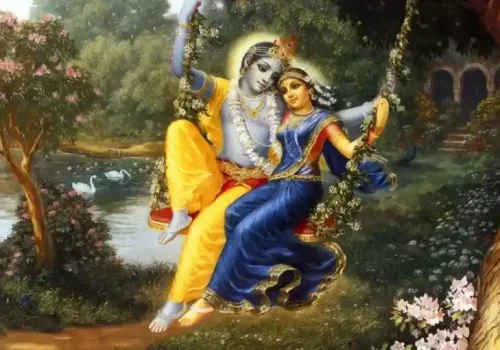
गगन सम अंग कांति काली, राधिका चमक रही आली।
लतन में ठाढ़े बनमाली; भ्रमर सी अलक, कस्तूरी तिलक,
चंद्र सी झलक, ललित छवि श्यामा प्यारी की॥
श्री गिरिधर कृष्णमुरारी की॥
आरती कुंजबिहारी की, श्री गिरिधर कृष्ण मुरारी की॥
कनकमय मोर मुकुट बिलसै, देवता दरसन को तरसैं।
गगन सों सुमन रासि बरसै; बजे मुरचंग, मधुर मिरदंग,
ग्वालिन संग; अतुल रति गोप कुमारी की॥
श्री गिरिधर कृष्णमुरारी की॥
आरती कुंजबिहारी की, श्री गिरिधर कृष्ण मुरारी की॥
जहां ते प्रकट भई गंगा, कलुष कलि हारिणि श्रीगंगा।
स्मरन ते होत मोह भंगा; बसी सिव सीस, जटा के बीच,
हरै अघ कीच; चरन छवि श्रीबनवारी की॥
श्री गिरिधर कृष्णमुरारी की॥
आरती कुंजबिहारी की, श्री गिरिधर कृष्ण मुरारी की॥
चमकती उज्ज्वल तट रेनू, बज रही वृंदावन बेनू।
चहुं दिसि गोपि ग्वाल धेनू; हंसत मृदु मंद,चांदनी चंद,
कटत भव फंद; टेर सुन दीन भिखारी की॥
श्री गिरिधर कृष्ण मुरारी की॥
आरती कुंजबिहारी की, श्री गिरिधर कृष्ण मुरारी की॥
आरती कुंजबिहारी की, श्री गिरिधर कृष्ण मुरारी की॥
आरती कुंजबिहारी की, श्री गिरिधर कृष्ण मुरारी की॥
Originally derived from: Traditional Braj Devotional Hymn
Presented by: Mukti Mantra
Meaning and Essence of the Lyrics of Aarti Kunj Bihari ki
The Lyrics of Aarti Kunj Bihari ki are not only an expression of praise but a spiritual journey. Each line carries layers of meaning that go beyond visual beauty, guiding the devotee towards inner awareness. Through imagery drawn from nature, Vrindavan, and divine leela, the verses reveal how Shri Krishna’s presence transforms the ordinary into sacred.
Krishna as Kunj Bihari and Giridhar
The opening line of Lord Krishna Aarti immediately places Shri Krishna at the centre of devotion, not as a distant deity but as one who resided in the kunj, the sacred groves of Vrindavan. Spiritually, Vriandavan represents the heart of a devotee, a space softened by love and humility where the divine chooses to dwell. By addressing him as Giridhar, the aarti recalls the moment when Krishna lifted the Govardhan Parvat to protect the people of Braj from the wrath of Indra. This act is not only remembered as a miracle but also as a timeless assurance that Krishna shields those who surrender without calculation.
Through the opening verse, this aarti teaches a foundational truth of bhakti that protection does not come from controlling circumstances, but from trusting the divine will. Just as Krishna asked the people of Braj to take shelter under Govaardhan with complete faith, the devotee learns to place life’s burdens at his feet and stand firm in devotion rather than fear.
The Vaijayanti Mala and Murli: Symbols of Spiritual Victory and Ego-less Devotion
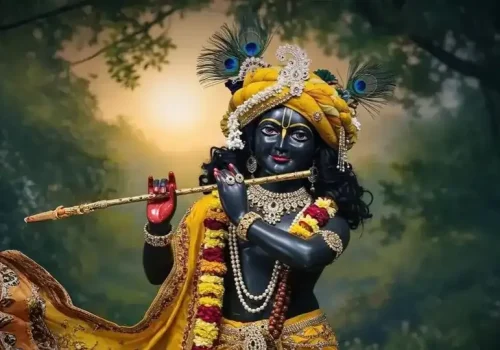
The lyrics of Aarti Kunj Bihari Ki then move forward to describe his divine appearance in the lines “Gale mein Baijanti mala, bajavai murli madhur bala.” What appears to be a description of Krishna’s adornments at first holds a profound spiritual message. The Baijanti mala, also known as Vaijayanti, comes from the Sanskrit root “Vijaya”, meaning victory or triumph. According to Vishnu Puarana and Bhagavata Purana, Vaijayanti mala is described as a divine garland worn by Krishna and Vishnu, and is made of five forest flowers. When worn by Krishna or Lord Vishnu, they symbolise their control over the panch tatvaa. Here, the Baijanti mala symbolises spiritual victory, victory over ego, pride, and attachment. It reminds the devotee that divine grace adorns only those who cultivate inner purity.
The line “bajavai murli madhur bala” draws attention to Krishna’s flute. The murli produces divine music only because it is hollow, without resistance or self-identity of its own. The flute symbolises the ideal devotee, empty of ego, free from personal assertion, and completely surrendered to the divine breath. When Krishna plays the murli, it is not the flute that creates music, but Krishna who flows through it. For the devotees, this becomes a spiritual instruction, when one releases ego, attachment, and self-centred desires, divine grace expresses itself naturally through life.
Shravan Bhakti and Nandlala: Krishna Who Listens and Lives in Love
The line “Shravan mein kundal jhalakala” in kunj bihari ki aarti highlights Krishna’s shining earrings, drawing attention to his ears. In Bhakti philosophy, this imagery is closely associated with shravan bhakti, the path of devotion through listening. Scriptures such as the Bhagavata Purana repeatedly emphasise hearing the Lord’s name, stories, and glories as the first and most accessible form of devotion.
By adorning Krishna’s Ears, the Lord Krishna Aarti conveys a subtle truth that Krishna listens. He is not an indifferent witness but an attentive presence who hears the sincere call of a devotee.
When the Aarti calls Krishna “Nand ke anand Nandlala”, it represents him as the source of joy in Nand Baba’s life. This description reflects a core teaching: despite being the ruler of all worlds, Krishna allows himself to be bound by parental love in Gokul. Krishna’s willingness to become Nandlala teaches that pure love has the power to draw the divine into human life. For the devotee, this becomes an invitation to approach God not as a distant authority but as a presence that delights in loving connections.
Radha-Krishna: The Union of Love and Conscious Awareness
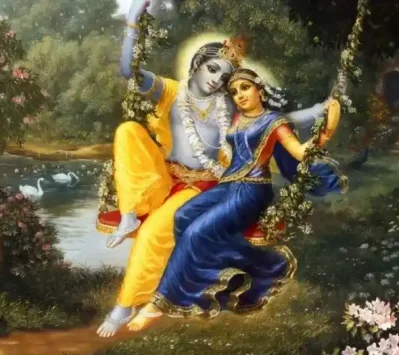
The verse “gagan sam ang kanti kaali, Radhika chamak rahi aali” opens with a striking visual and spiritual contrast that lies at the very heart of Krishna Bhakti. The verse describes Shri Krishna’s ang Kanti, the radiance of his body, as gagan sam, like the vast sky itself. The word Kaali here does not merely indicate blackness; it evokes the deep and infinite blue sky, limitless, all-encompassing, and unfathomable. Here, Krishna’s dark complexion symbolises the infinite Brahmand, beyond form yet fully present within form.
Against Krishna’s boundless and dark radiance stands Radha. The verse “Radhika chamak rahi aali” draws attention to Radha’s luminous presence, creating a contrast. While Krishna represents absolute consciousness, Radha, as his hladini shakti, represents the power of devotion and love that allows that consciousness to be experienced. Their togetherness conveys that the divine is never complete without bhakti.
The Living Presence of Krishna in Nature and Love
The following verses, “latan mein thaadhe Banmali”, place Krishna within the living heart of Vrindavan. As Banmali, the wearer of forest garlands, Krishna stands among vines and creepers, not in places or celestial halls, showing that Krishna chooses simplicity over grandeur.
The lyrics of Aarti Kunj Bihari ki then move into detailed imagery in the lines, “bhramar si alak”, comparing Krishna’s locks of hair to honeybees. The Bhramar also symbolises movement, attraction, and life. His hair appears alive, gently hovering, naturally enchanting, suggesting that his beauty is effortless and irresistibly magnetic.
Further, “kasturi tilak” describes the musk tilak adorning Krishna’s forehead. Kasturi, prized for its rare and lingering fragrance, symbolises purity and sacredness. Placed on the forehead, it reflects inner clarity and divine awareness, stating that Krishna’s beauty flows from purity and not ornamentation alone.
The line “chandra si jhalak” compares Krishna’s radiance to the moon, expressing his compassionate, soothing presence. The verse concludes with “lalit chhavi Shyama pyari ki”, describing Krishna’s form as lalit, meaning graceful, gentle, and beautiful, and calling him Shyama pyare, the beloved of Radha.
Krishna’s Splendour and Radha’s Incomparable Love: Lessons in Bhakti
The verse “kanakmay mor mukut bilsai” describes Krishna adorned with peacock feathers. The word Kaanakamy highlights its golden radiance while Bilsai conveys how it shines with effortless beauty. The peacock feather, light and graceful despite its splendour, reflects Krishna’s nature, supreme yet humble.
The next line, “devta darsan ko tarsain”, says that even the devtas long for a single glimpse of Krishna in this form. Though the devtas possess power and position, they still learn for Krishna’s darshan. This reminds us as devotees that divine closeness is not gained through status or authority, but through love and devotion.
The Lyrics of Aarti Kunj Bihari ki further say that the heavens themselves respond to Krishna’s presence as Flowers rain down from the sky, as if nature joins the celebration. The atmosphere then fills with sound and rhythm in “baje murchang, madhur mirdang, gwalin sang.” Musical instruments like murchang and the sweet-sounding mirdang play alongside the gopis. This moment shows that bhakti is not silent or restrained; it is alive, rhythmic and overflowing with emotion.
The verse concludes with “atul rati Gop Kumari ki,” declaring that the beauty and love of Radha, the daughter of the cowherd, are incomparable. Atul means beyond measure, and rati expresses both beauty and deep emotional devotion.
Amidst divine music, falling flowers and celestial admiration, Radha’s love stands unmatched. Together, these lines show a divine celebration where beauty, music, nature and devotion move in harmony. They teach that when love becomes pure and selfless, even the heavens respond and the divine reveals himself in joy rather than distance.
Divine Purification and Surrender:
The verse “jahan te prakat bhai Ganga, kalush kali haarini Shri Ganga” speaks of the sacred power and origin of the river Ganga. It describes her as the remover of impurities in Kaliyuga. The line “smaran te hot moh bhanga” states that remembrance of the divine breaks moh, the illusion of attachment that binds the soul. This reflects a key teaching of Bhakti, that constant remembrance of Krishna gradually frees the mind from ego and worldly attachment.
In “basi Shiv sees, jata ke beech,” the verse recalls how Ganga flows through Lord Shiva’s matted locks. This image symbolises control and balance, showing that divine power reaches the world through restraint and awareness. The following line, “harai agh keech,” assures the devotee that divine grace can remove even deeply rooted sin and inner heaviness.
The verses conclude with “charan chhavi Shri Banwari ki,” drawing attention to the beauty of Krishna’s feet. In Bhakti, the lord’s feet represent refuge and surrender. The aarti gently reminds the devotee that purification and liberation find their completion in taking shelter at the feet of Shri Giridhar Krishna Murari.
The Living Vision of Vrindavan: Where Divine Sound, Grace, and Liberation Unite
At last, the Lyrics of Aarti Kunj Bihari ki describe Vrindavan as a living, breathing and divine experience. “Chamakti ujjwal tat renu, baj rahi Vrindavan benu” describes a landscape glowing with purity, where even dust reflects sacredness and the flute of Shri Krishna flows continuously through the air. As “chahun disi gopi gwaal dhenu” unfolds, the scene expands in all directions. Gopis, cowherds and cattle move in natural harmony, symbolising a world aligned with dharma, simplicity and love. Life here revolves not around effort or struggle, but around presence in the divine rhythm of Krishna’s leela.
The tone softens with “hansat mridu mand, chandni chand”, revealing Krishna’s gentle smile, calm, compassionate, and reassuring, like moonlight soothing restless hearts. Through “katat bhav phand”, the verse affirms that mere connection with this divine presence dissolves worldly bondage. Liberation is not achieved through force, but through grace.
Finally, “ter sun deen bhikhari ki” establishes Krishna as the eternal responder to sincere devotion. He actively hears, acknowledges, and uplifts his devotees. This passage stands as a spiritual testimony, rooted in bhakti tradition, that where Krishna’s presence is felt, suffering loosens, faith strengthens, and the soul finds its way home.
Final Thoughts on Lyrics of Aarti Kunj Bihari ki
Taken together, these Lyrics present Shri Krishna not as a distant deity, but as an ever-present guide and protector. His flute awakens the soul, his smile dissolves fear, and his compassion responds even to the faintest call of devotee, deen bhikhari ki ter. The Lord Krishna aarti gently reminds us that liberation is not found through effort alone, but through surrender, remembrance and love. When sung with understanding, this aarti becomes a living connection, cutting through worldly bounds and leading the soul towards peace, grace and divine belonging.
Know more about Lord Krishna Aarti
Here are some common questions people often ask after reading Lord Krishna’s Aarti:
Krishna is called Kunj Bihari because he dwells and plays in the kunj, the natural groves, bowers and vine-covered forest of Vrindavan. The word kunj refers to leafy pathways formed by creepers and flowering plants, while Bihari means one who joyfully moves, wanders, or delights. Together, Kunj Bihari describes Krishna as the One who freely roams and performs divine leelas in these intimate forest spaces.
Krishna lifted Govardhan Parvat to protect the people of Vrindavan from the wrath of Indra Dev. According to the Bhagavata Purana, the people of Vrindavan traditionally worshipped Indra, the god of rain, believing their survival depended solely on his favour. Krishna gently questioned this practice and guided them to worship Govardhan Parvat, the land that directly sustained them, providing grass for cows, water, shelter, and nourishment. Angered by this change, Indra unleashed heavy rains to punish the people of Braj. In response, Krishna effortlessly lifted Govardhan Parvat on his little finger, holding it for seven days and nights to shelter the people of Braj. This incident also led to him being called Girdhari.
Krishna wears a peacock feather (Mor-Pankh) as a symbol of his eternal bond with Shri Radha and as a fulfillment of a promise made in his previous incarnation as Lord Rama.
According to the Vaishnav tradition, it has a connection to his past incarnation. In Ramayana, Shri Ram was once helped by a peacock; he blessed it and promised to honour it in his future incarnation. That promise is fulfilled in His form as Shri Krishna.
In Vaishnava tradition, the peacock feather is considered dear to Shri Radha, making it a sign of Krishna’s eternal bond with Her. Thus, when Krishna wears it, He wears Radha’s love itself upon His head.
Krishna is called Banke Bihari because of His tribhangi (three-fold bent) posture, where His body curves gracefully at the neck, waist, and legs. The word “Banke” means bent or curved, and “Bihari” means one who joyfully roams. Together, the name describes Krishna, who moves playfully with a charming, curved stance.
In Vrindavan, Banke Bihari represents Krishna in his most intimate, playful and compassionate form, where devotion is based not on fear or ritual but on affection and surrender.
According to the Bhagavata Purana, Harivamsa Purana, and Vishnu Purana, Lord Krishna had many sons, the most well-known being Pradyumna, born to Rukmini. Pradyumna is revered as an incarnation of Kamadeva (the god of love).
Other prominent sons of Krishna include Samba, Aniruddha, Charudesna, Gada, Bhanu, and Subhadra’s lineage through Abhimanyu (as a grandson). Collectively, the scriptures mention that Krishna had 16,108 wives and 161,080 sons, symbolising divine expansion rather than ordinary lineage.
In devotion, however, Krishna is worshipped less as a father and more as the eternal child (Bal Gopal) or the beloved Lord, beyond worldly family roles.
Related Posts
- All Posts
- Aarti
- Bhajan
- Chalisa
- Stotram
- Stuti
- Back
- Shiva
- Hanuman
- Shri Radha
- Durga
- Lakshmi
- Back
- Ganesh Ji
- Maha Lakshmi
- Lord Vishnu
- Durga Maa
- Shiva
- Back
- Krishna Bhajan
- Back
- Shri Radha
- Back
- Shri Ram
Radhe Radhe Bol Shyam Aaegye Lyrics in English and Hindi: The bhajan “Radhe Radhe Bol Shyam Aayenge” expresses a beautiful...

Achyutam Keshavam Lyrics in English: More than just a bhajan, Achyutam Keshavam is a heartfelt expression of love and devotion...
Radha Chalisa- जय वृषभानु कुँवरी श्री श्यामा।कीरति नंदिनी शोभा धामा । नित्य बिहारिनी श्याम अधारा।अमित मोद मंगल दातारा । भक्ति...