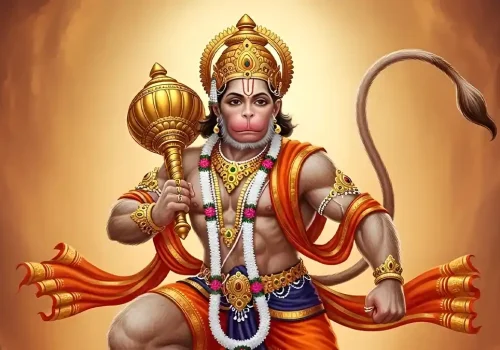
One of the most interesting mysteries surrounding the Hanuman Chalisa distance of Sun is a verse that many believe accurately describes the distance between the Earth and the Sun.
Written over 400 years ago by Goswami Tulsidas Ji, the Hanuman Chalisa is mainly a devotional hymn for Lord Hanuman. However, one verse has caught the attention of devotees, historians, astronomers, and researchers because its numerical interpretation closely matches the current scientific estimate of the Earth-Sun distance.
In this article, we will explore the meaning of the verse, the traditional calculation, and how it compares to modern astronomical measurements.
Distance between Sun and Earth in Hanuman Chalisa
One of the most talked-about verses in the Hanuman Chalisa is:
“जुग सहस्त्र जोजन पर भानु, लील्यो ताहि मधुर फल जानु।”
(Jug sahasra yojan par bhanu, leelyo taahi madhur phal jaanu.)
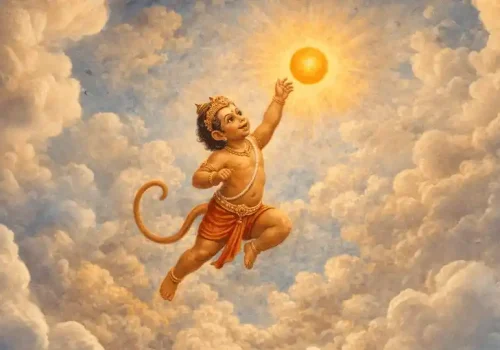
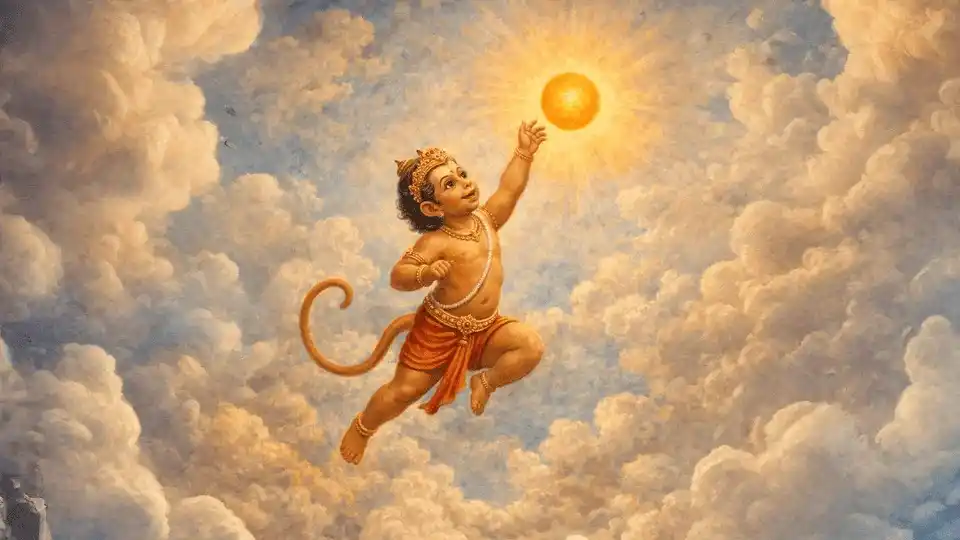
In this verse, Goswami Tulsidas Ji tells the well-known story from Lord Hanuman’s childhood. He jumped toward the Sun (Bhanu), thinking it was a sweet fruit (Madhur phal). In recent years, many devoted followers and scholars have looked at the traditional measurements in the verse. They discovered that the calculated distance is surprisingly close to the current average distance from the Earth to the Sun.
Decoding the Distance
The calculation is based on traditional Indian units of measurement.
| Ancient Unit | Meaning |
|---|---|
| Jug (Yuga) | 12,000 |
| Sahastra | 1,000 |
| Yojan | Approximately 8 miles (12.8 km) |
Using these traditional values:
12,000 × 1,000 × 8 miles= 96,000,000 miles
Converting miles into kilometres:
96,000,000 × 1.6 ≈ 153.6 million kilometres
Also Read:
Distance Between Earth and Sun According to Modern Science
According to modern astronomy, the average distance between the Earth and the Sun is approximately 149.6 million kilometres (92.96 million miles). Scientists determine this value using advanced observations, satellites, radar measurements, and space missions. Since the Earth revolves around the Sun in an elliptical orbit, this distance changes slightly throughout the year, but 149.6 million kilometres is accepted as the average distance, also known as 1 Astronomical Unit (AU).
When the traditional interpretation of the Hanuman Chalisa verse is compared with this modern scientific value, the figures appear remarkably close.
| Source | Approximate Distance |
|---|---|
| Hanuman Chalisa Interpretation | ~96 million miles (153.6 million km) |
| Modern Scientific Estimate | ~93 million miles (149.6 million km) |
The difference is relatively small considering the verse was composed centuries before telescopes, satellites, and modern space science, and this similarity has made the Hanuman Chalisa’s distance to the Sun one of the most widely discussed topics among devotees and researchers.
The Story Behind Hanuman Ji's Leap Toward the Sun
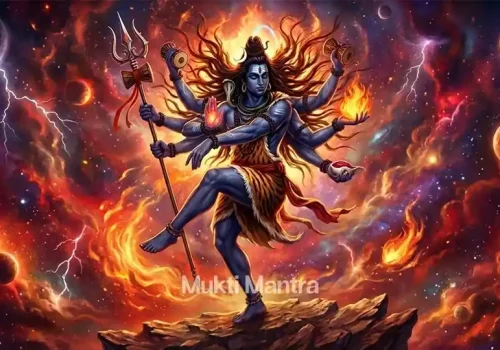
According to the Valmiki Ramayana, being the 11th Rudra incarnation of Lord Shiva, Hanuman Ji possessed immense divine powers from birth. But he had no control over those powers, as he was just a Child.
One morning, young Hanuman Ji felt hungry and began searching for ripe fruits in the forest. After finding that the fruits on the trees were not sweet enough, he looked up and noticed the bright, golden Sun shining in the sky. Thinking it was a ripe fruit, he leapt towards it with incredible speed.
Seeing this, Lord Surya got worried as Hanuman possessed enough powers to actually eat the Sun. He prayed to Lord Indra for protection, and Indra struck Hanuman Ji with his Vajra (thunderbolt), causing him to fall back to Earth.
Seeing Hanuman injured, Vayu Dev, Hanuman’s father, withdrew Air from the universe in anger. The Gods soon realised their mistake and blessed Hanuman with numerous divine boons:
- Lord Brahma: Granted immunity from the Brahmastra and all weapons in war. He also gave him the ability to change his size or form at will, travel anywhere, and the power to remove fear in friends.
- Lord Shiva: Granted invincibility, ensuring Hanuman could never be killed by Shiva’s weapons or by Shiva Himself.
- Lord Indra: Blessed him so that his body would be stronger than the Vajra, and granted him the boon of Iccha Mrityu (the ability to choose the time of his own death).
- Lord Surya (Sun God): Granted him a fraction of his own brilliance, making Hanuman radiant, and blessed him to be a master of all scriptures.
- Lord Varuna (God of Water): Granted immunity and protection from death by water or his noose.
- Lord Yama (God of Death): Granted immunity from his rod of chastisement (Danda) and guaranteed eternal good health.
- Lord Kubera (God of Wealth): Granted the boon that his mace would not fail or cause fatigue in combat, and that Hanuman would always remain joyous and content.
- Lord Agni (God of Fire): Granted total immunity from burning by fire.
- Vishwakarma (Architect of the Gods): Made Hanuman invulnerable to all weapons crafted by him.
This childhood episode later became one of the most beloved stories associated with Lord Hanuman and inspired the famous verse in the Hanuman Chalisa.
Know more about Hanuman Ji
Here are some common questions people often ask about Hanuman Ji after reading Hanuman Chalisa:
Yes. The verse "Jug Sahastra Yojan Par Bhanu" is interpreted by many scholars as describing the distance between the Earth and the Sun using ancient Indian units of measurement.
Using traditional conversions, the phrase "Jug Sahastra Yojan" equals approximately 96 million miles (153.6 million km).
Modern science estimates the average distance to be approximately 93 million miles (149.6 million km).